Walk into any hardware store and every drill box shouts the same three things: volts, torque, and price. None of those numbers tells you whether the tool will still be boring straight holes five years from now. A 20V cordless drill kit is really four decisions bundled into one box. There is the battery platform you are marrying into, the motor design inside the housing, the chuck that holds the bit, and the accessories that come in the case. Get those four right and a mid-priced kit will outlast a cheap one two or three times over. Get them wrong and you will be shopping again before the second winter.
I ran a general contracting crew in Cleveland for 22 years, and the graveyard wall in my shop holds roughly 30 dead power tools. Almost every one of them died for one of two reasons: a brushed motor that wore itself out, or a battery platform that got discontinued before the drill did. Neither failure shows up on a spec sheet, and neither one is fixed by the torque number printed in six-inch letters on the front of the box.
Related: Cordless Drill Battery Platforms Compared →
Quick answer
A 20V cordless drill kit is a drill, one or two batteries, a charger, and a bag that all share a single battery platform. For furniture assembly, curtain rods, and light hanging, a compact kit with a variable speed trigger and a 3/8-inch keyless chuck covers most of it. For repeated driving into framing lumber or deck boards, or for anything you do for a living, a brushless drill or a drill-and-impact-driver combo kit is the more durable choice, because there are no carbon brushes to wear out and no drill chuck doing work that belongs to an impact driver. Buy for the work you do in a normal month, not for the one weekend a year you build something big.
Three useful options
| Model | Best fit | What stands out |
|---|---|---|
| DEWALT 20V Max Cordless Drill Driver Set, 2 Speed, High Performance Motor, Includes 2 XR 1.3Ah Li-Ion Batteries, Charger and Contractor Bag (DCD771C2) | Buyers who want a known platform and a spare battery on day one | Two XR 1.3Ah Li-Ion batteries, a charger, and a contractor bag ship in the box |
| AVID POWER 20V Cordless Drill Set for Home DIY & Beginner Projects - Lightweight Power Drill with Battery Charger & 22 Bits, Variable Speed, 3/8" Keyless Chuck, Ideal for Furniture Assembly (Red) | First drills, flat-pack furniture, light household repair | Battery, charger, and 22 bits included at the lowest entry point of the three |
| DEWALT 20V MAX Cordless Drill and Impact Driver, Power Drill Brushless 2-Tool Power Tool Combo Kit, Includes 2 Batteries, Charger and Bag (DCK277D2) | Anyone driving a high volume of fasteners | Brushless drill plus a matching impact driver, two batteries, charger, and bag |
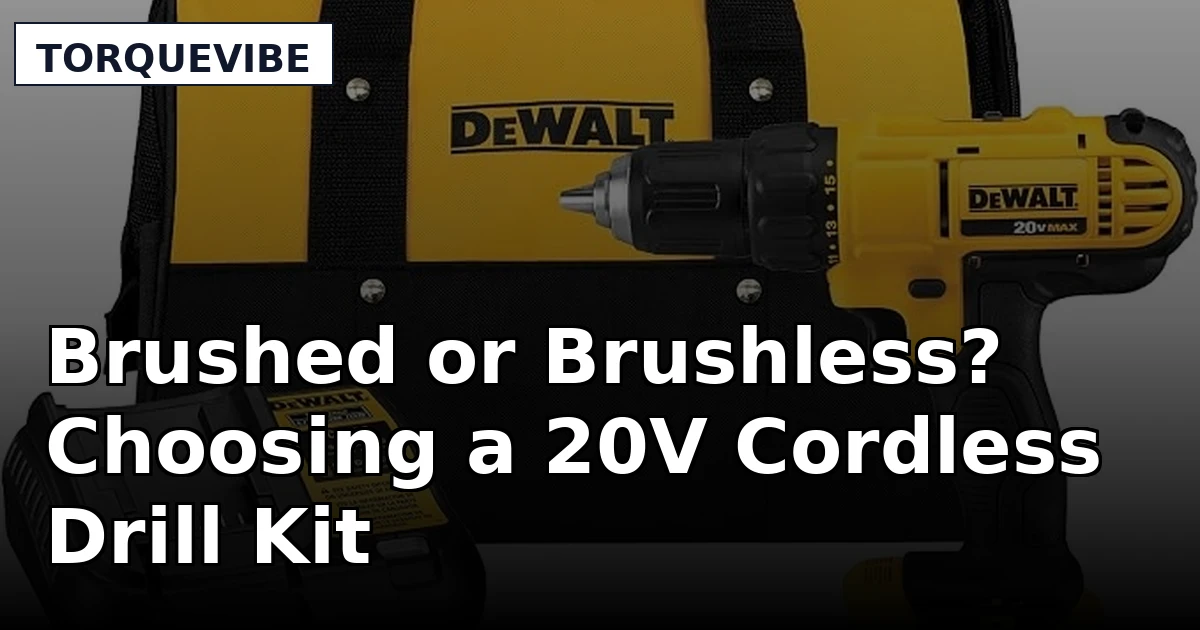
The platform starter: DEWALT 20V Max Cordless Drill Driver Set (DCD771C2)
The case for this kit is not the drill, it is the two batteries. A single-battery kit stops working the moment the pack is flat, and packs always go flat in the middle of a job. Two packs mean you can keep working while one charges, and the 1.3Ah size keeps the drill light enough to hold overhead for a while. The trade-off is runtime per charge: compact packs like these are built for light and moderate work, not for an afternoon of driving long screws into pressure-treated lumber. If your work leans heavy, plan on adding larger-capacity packs later, which is exactly the point of buying into a platform instead of a one-off tool.
The budget starter: AVID POWER 20V Cordless Drill Set
The honest trade-offs here are about duty cycle and bit shank size, not about brand snobbery. A 3/8-inch chuck takes 3/8-inch and smaller shanks, so it will not hold the 1/2-inch spade bits you would use to run cable through a joist. The included 22 bits are a starter assortment rather than a lifetime supply, and the small ones will round off eventually. And because this is a single-tool kit rather than a system, the battery that fits it will not run a different brand's saw or light later. For assembling a bookshelf or hanging a ceiling fan, none of that matters. For building a deck, all of it does.
The two-tool step up: DEWALT 20V MAX Cordless Drill and Impact Driver (DCK277D2)
The reason to own both tools is not that two is better than one. It is that a drill is the wrong tool for long screws. Driving a 3-inch deck screw with a drill means the chuck and the clutch absorb all of that resistance, and over a season that is what kills drills. An impact driver applies rotational force in short hammering bursts through a hex collet, so the fastener breaks loose instead of the tool fighting it. If you are driving more than a handful of screws in a session, the second tool pays for itself in reduced wear on the first.
Prices and availability may change. Product images, names, and retailer links must be matched by verified ASIN. Do not state a current price, rating, stock status, or measured result without current evidence.
Brushed and brushless: what the motor actually means
A brushed motor uses carbon blocks, called brushes, that ride against a spinning commutator to transfer electrical current. Those brushes are a wear item. Every hour of runtime shaves them down a little further, and when they are gone the tool stops, often in the middle of a project. That is not a defect, it is the design. Brushed motors are simpler and cheaper to build, which is why they show up in entry-level kits.
A brushless motor replaces the brushes and commutator with electronic switching. Fewer contact parts means less friction, less heat, and less energy lost as waste, so a brushless tool generally gets more work done per charge and tends to survive far more hours before anything wears out. The cost is up front, and it is the main reason a brushless combo kit sits higher in the lineup than a brushed single drill.
There is a second, quieter factor that decides how long a kit stays useful: the battery platform. A drill is the first tool you hang on a battery system, not the last. Once you own packs and a charger, every future tool, whether a saw, a light, or a second drill, is cheaper because it comes as a bare tool. That is why the platform matters more than any single spec, and why a discontinued battery line turns a perfectly good drill into wall art. Twenty years in this trade taught me that the battery is the purchase and the drill is the accessory.
How to choose in five steps
- Write down the five jobs you will realistically do this year, then be honest about whether any of them involve lumber thicker than a two-by-four. That answer decides whether you need brushless at all.
- Count the batteries. If you work in sessions longer than a single charge, two packs matter more than any feature on the spec sheet, and a kit with two included batteries usually costs less than buying a spare later.
- Match the chuck to your bits. A 3/8-inch keyless chuck handles twist bits and hex-shank accessories; if you plan to run 1/2-inch spade or auger bits, you need a drill that accepts them.
- Decide whether you need an impact driver as well. If screws are the main event rather than the occasional task, a combo kit is the better structure because each tool does the job it was designed for.
- Look past the drill. Check what else runs on the same battery, whether replacement packs and parts are commonly available, and whether the brand keeps a platform alive long enough to be worth joining.
Getting more out of the kit you buy
- Set the clutch collar below the drill setting when driving screws. The clutch stops the chuck from turning once the screw seats, which is what prevents stripped heads and punched-through drywall.
- Let the tool do the work. Pushing hard on a drill slows the motor, heats the battery, and wears the brushes faster without making the hole any quicker.
- Charge packs before they are completely flat and store them out of a freezing garage. Battery capacity fades with abuse, and cold weather is the fastest way to make a healthy pack act dead.
- Keep the chuck jaws clean. Sawdust packed into the jaws is the most common reason a chuck starts slipping, and a slipping chuck chews up bit shanks.
- Buy bits that match the material. A sharp bit designed for the material you are drilling draws less power than a dull general-purpose bit, which is easier on the motor and the battery alike.
Which option should you choose?
Choose the DEWALT 20V Max Cordless Drill Driver Set (DCD771C2) when you want a complete kit from an established battery platform, with two batteries so a flat pack never ends your afternoon. Choose the AVID POWER 20V Cordless Drill Set when the work is furniture assembly, light household repair, and occasional drilling, and you want a lightweight tool with a bit set included rather than a long-term platform commitment. Choose the DEWALT 20V MAX Cordless Drill and Impact Driver (DCK277D2) when driving fasteners is a regular part of your work and you would rather split drilling and driving between two brushless tools than wear out one drill doing both.
None of these kits is a substitute for matching the tool to the task. A drill that is right for assembling a desk will feel underpowered boring through wet lumber, and a heavy combo kit is more tool than a one-bedroom apartment needs. Nothing here should be judged by a torque figure on a box, since that number says nothing about how the tool behaves after the battery has been cycled a few hundred times.
The bottom line
A 20V cordless drill kit is a battery platform purchase disguised as a tool purchase. The AVID POWER set is the least expensive way to get a working drill, battery, charger, and bits into your hands for light household work. The DeWalt drill driver kit is the sensible middle, with two batteries, a charger, and a bag on a platform that runs a whole lineup of tools. The DeWalt brushless combo kit is the one built for volume, because a brushless drill and a separate impact driver each do the job they were designed to do instead of asking one chuck to handle everything. Pick the kit that matches the work in front of you, then keep the batteries charged and the chuck clean, and it will be a long time before anything of yours ends up on a graveyard wall.