Most people shopping for their first drill ask the wrong question. They want to know which drill is best, and they want a number printed on the box to settle the argument. The question that actually matters is corded vs cordless drill, and the answer depends on where you are standing when you need the hole. On a ladder over a deck frame, cordless wins by default because there is no outlet up there. In a basement shop with a hundred pocket holes to drill and an extension cord already run, the corded drill wins and it is not close.
I ran a contracting crew in Cleveland for 22 years, and I have burned out more drills than most people will ever own. Every one of them is on the graveyard wall in my shop. That wall started as a joke and turned into the most honest review system I know, because nothing gets up there without earning its death.
The drill itself is the cheap part. The battery platform is the real purchase, and it is the decision you will still be living with ten years from now.
So here is how to decide, and here are the two drills I point homeowners and new apprentices toward when they ask me this exact question.
Why you should trust me
Twenty-two years of decks, basements, kitchens, and the whole rusty Midwest menu. I have smoked brushed motors on three-inch deck screws, watched chucks slip on brand new bits, and had batteries die at the exact worst moment of a Friday afternoon. Every tool that died on my jobsite ended up on the wall, and I can tell you the story of each one.
What that taught me is simple. Spec torque is measured on a fresh battery with a warm motor. Real torque is what is left after 50 screws, a tired arm, and a 40-degree Cleveland morning. I do not review drills off a spec sheet, and I do not trust anybody who does.
The three questions that settle corded vs cordless
Answer these before you look at a single drill.
Where does the work happen? In the house, near an outlet, in a shop or a garage: corded is on the table. On a roof, a deck, a fence line, or a ladder: cordless, no debate.
How much of it is there? Two holes for a shelf bracket is a different job than 200 screws in a deck. A corded drill runs at full power until you unplug it. A battery drill tapers as the pack drains, which is why the last twenty screws of a long day always feel like work.
What platform am I buying into? Nobody thinks about this one, and it is the most expensive mistake in the category. You are not buying a drill. You are buying into a battery system you will still be feeding in ten years. A cordless drill on a platform that nobody supports in five years is a paperweight with a chuck.
What the numbers on the box actually mean
Inch-pounds is the torque unit you will see on every box. A big number sells drills, but torque is not the same thing as control. The clutch is the collar behind the chuck that stops the drill from spinning at a set torque, and it is the feature that keeps you from burying a screw through drywall or snapping a head off in hardwood. If a drill has no usable clutch range, it will lie to you on every cabinet job you ever do.
Brushless is the other word worth understanding. A brushless motor has no carbon brushes to wear out, which means more runtime per charge, more power from the same battery, and usually the difference between a tool that lasts a season and a tool that lasts a decade. It is not a marketing word. It is the reason a pro-grade drill costs what it costs.
The chuck is where cheap drills give themselves away. Three jaws that bite and hold are worth more than any number printed on the side of the box. A chuck that slips is a tool that lies.
The two drills I would start you on
Both of these are Black+Decker, both are aimed at the homeowner and the first-timer, and both are honest tools for the money. I picked them for the same reason I keep a cheap drill in my own truck: for the jobs where a good tool would be wasted, and for the beginner who needs to learn technique before they need horsepower.
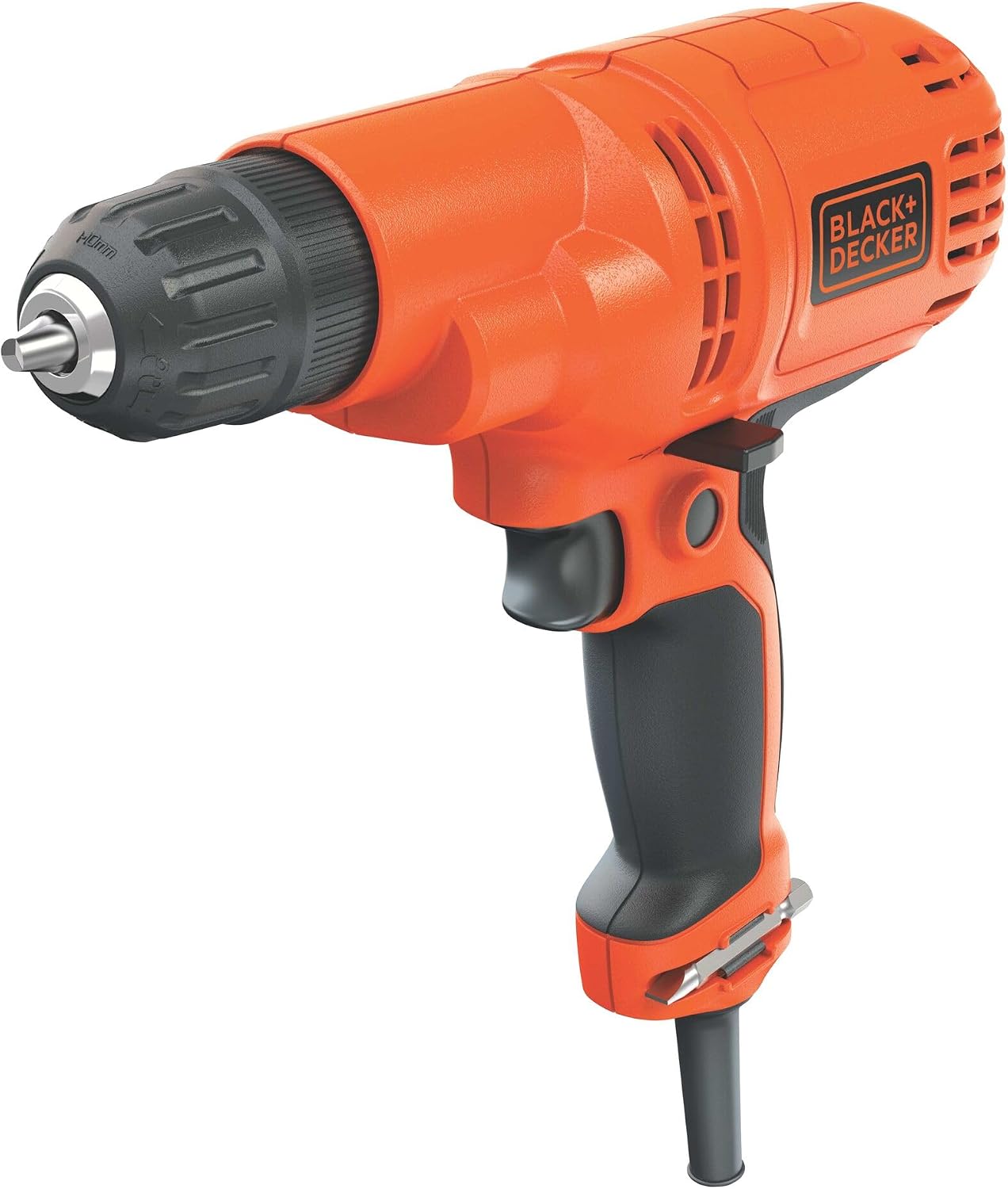
Budget pick: BLACK+DECKER Corded Drill, 5.5-Amp, 3/8-Inch (DR260C)
 Visit on Amazon →
This is the drill I tell people to buy when they have a project list and no tools. It plugs in, so there is no battery to babysit, no charger to lose, and no platform commitment. Five and a half amps and a 3/8-inch chuck cover the real work a house asks for: pilot holes, shelf brackets, curtain rods, picture hangers, a fence picket that came loose, a pine board that needs a hole in it.
A corded drill also teaches technique better than a battery drill does. It never runs out of power, so when a hole goes crooked or a screw strips, the tool is not the excuse. You learn to set the clutch, keep the bit straight, and let the motor do the work.
Flaws but not dealbreakers: You are tethered to an extension cord, and a 3/8-inch chuck will not take the big half-inch shank bits a heavy remodel wants. For deck building and framing, this is not the drill.
Anyone with a house, a short project list, and an outlet within reach of the work gets their money's worth here.
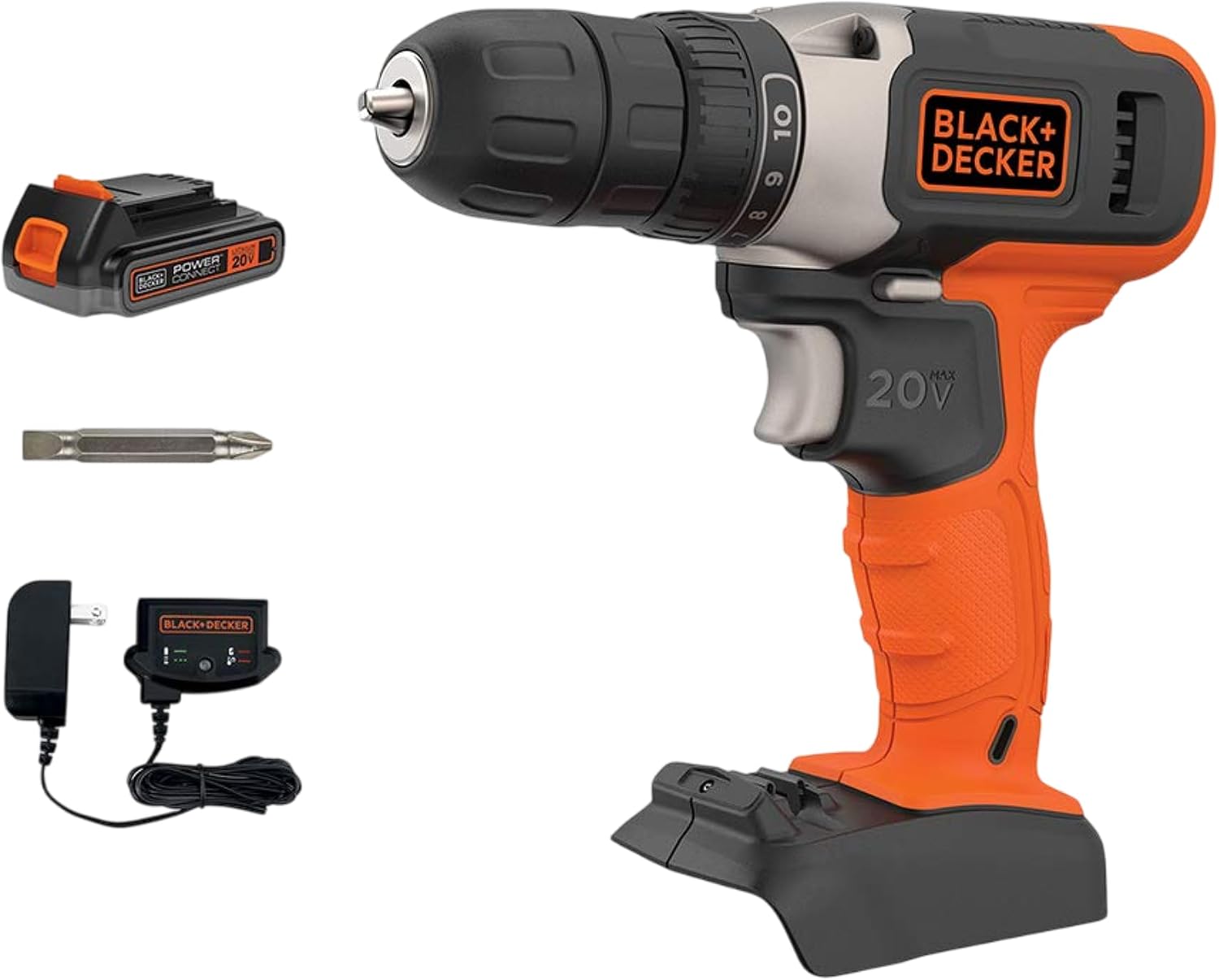
Our pick: BLACK+DECKER 20V MAX Cordless Drill Kit with Battery, Charger, Includes Double Sided Drill Bit (BCD702C1)
 Visit on Amazon →
If you only own one drill, this is the one to own, and it comes down to the platform. The kit includes the battery, the charger, and a double sided drill bit, so it is a complete start rather than a drill body you have to finish paying for. That battery is the beginning of a system: once you own the pack and the charger, every other tool on the line gets cheaper.
For a homeowner this is the correct first purchase, because it removes the excuse. It lives in a bag in the closet, it works in the backyard where there is no outlet, and it does not care whether the power in the garage is on.
Flaws but not dealbreakers: The 20V MAX label is a peak figure, not the voltage you get all day long. Do not buy this expecting it to drive 200 deck screws on one charge, because it will not, and it was never built to. This is a homeowner drill for homeowner work. If you are building a deck, you want a brushless pro-grade drill and an impact driver, which is a different article and a different budget.
Anyone who wants one drill that covers the house, the yard, and the car should start here.
How to use a drill without stripping screws
The tool is half the job. This is the other half, and it is the part nobody teaches.
Step one: set the clutch before you drive anything. Start low. If the clutch ratchets before the screw is seated, bump it up one number and try again. On softwood and drywall, the low numbers are your friends. On hardwood, you want more torque and a pilot hole.
Step two: drill a pilot hole. In hardwood, in anything near an edge, and in any board you cannot afford to split, drill a pilot hole a size smaller than the screw shank. This one habit prevents more ruined projects than every other technique combined.
Step three: keep the bit straight and let the drill do the work. Leaning on the back of a drill does not make it cut faster. It rounds out the hole, burns the bit, and on a battery drill it eats the charge. Slow hands, fast work.
Step four: match the bit to the job. A spade bit for rough holes in framing, a twist bit for metal, a brad point for clean holes in wood, a driver bit for screws. A dull bit is the reason your drill feels weak.
Step five: take care of the battery. Charge it before it is completely dead, store it out of a freezing garage, and do not leave it sitting on the charger for a month. A pack that gets treated right is a pack you will still be using when the drill body wears out.
Step six: know when to stop. A drill drives screws. It is not an impact driver. If you are driving long screws into hardwood all afternoon, you want an impact driver with a quick-release collet, not a drill with a chuck.
Where people go wrong
The biggest mistake is buying torque instead of control. A homeowner does not need 1,200 inch-pounds. They need a clutch that holds a setting and a chuck that bites.
The second mistake is buying into a dead platform. Before you buy any cordless tool, look at what else runs on that battery. If the answer is not much, you are buying a drill and a future paperweight.
The third mistake is using a drill where an impact driver belongs, and the fourth is cheap bits. Bits are consumables. Buy decent ones and replace them when they dull, because a three-dollar bit can cost you a forty-dollar board.
The last one is buying a tool for the job you wish you had instead of the job you actually have. A corded drill in a shop and a cordless drill in a truck are both correct answers. Buying a pro-grade drill to hang two pictures is not wrong, it is just money you did not need to spend yet.
What this all costs
I am not going to quote you a number that changes every other week. Check current Amazon price on both and do the math yourself, because the number that matters is not the sticker. It is cost per year of service.
A corded drill has no battery to replace, so its cost per year is basically the purchase price divided by however long it lasts. A cordless drill carries a battery that will eventually need replacing, but it also opens a platform, and the second tool on that platform costs less than the first.
For a homeowner, the honest math is this: one cordless drill kit plus a decent bit set covers about 90% of what a house will ever ask of you. Add the corded drill later if you end up doing shop work, sanding, or mixing, which is exactly the job where a cord that never runs out of power is the right tool.
The bottom line
If you work near an outlet and you want the most tool for the least money, buy the corded drill. If you want one drill that lives in the closet and works anywhere, buy the cordless kit and start building a platform around it.
Either way, the drill is not the thing that makes the holes. You are. Set the clutch, drill the pilot hole, keep the bit straight, and let the tool do the work. That is the whole secret, and it has not changed since I was an apprentice.