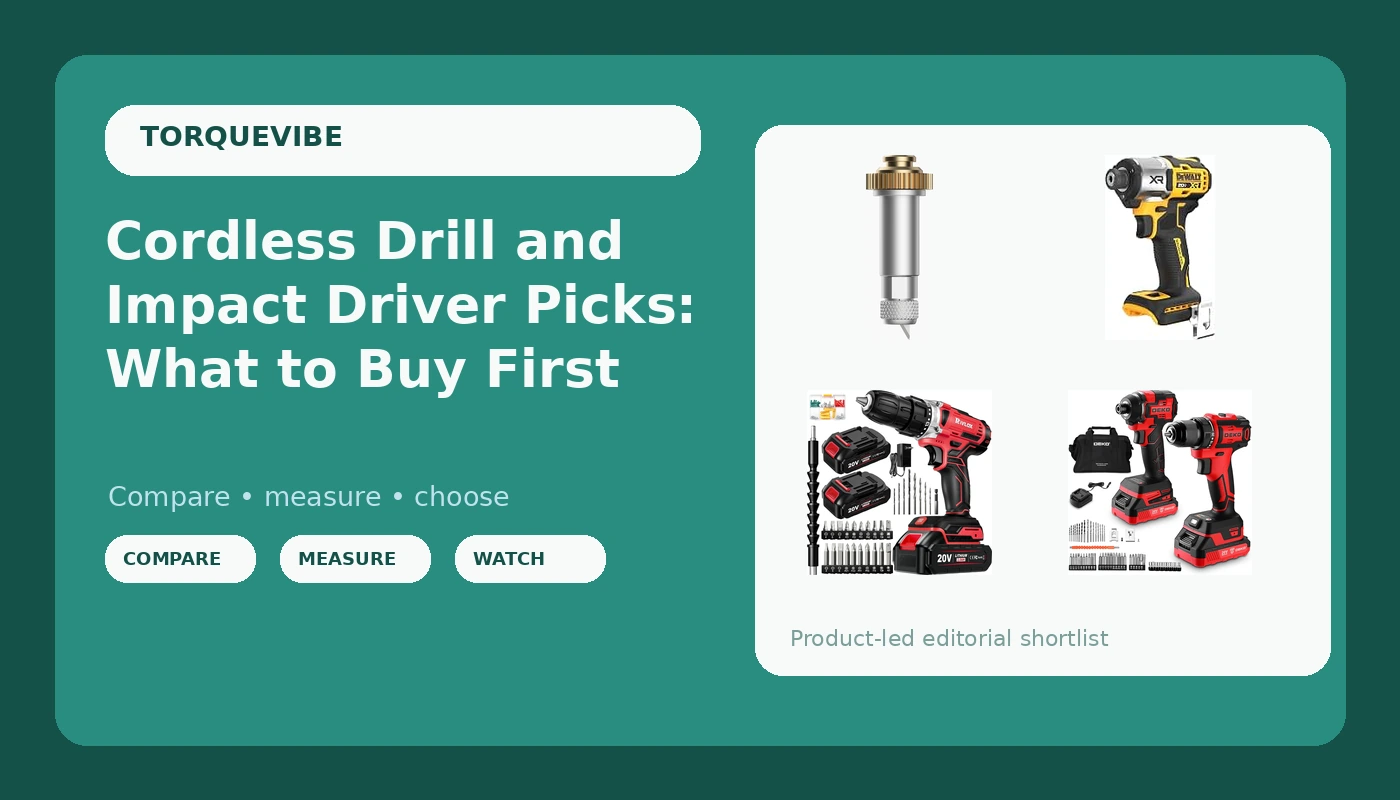
Most people shopping for a cordless drill and impact driver are trying to answer the wrong question first. They compare inch-pounds on a spec sheet, pick the biggest number, and then find out six months later that the battery they bought into is the thing they are actually stuck with. I have watched that happen on my own crew more times than I can count. The drill is the cheap part. The platform is the commitment.
Related: Brushless vs Brushed Drills: What Actually Wears Out →
Quick answer
If you already own tools that share a battery system, buy the tool that fits that system, even if another brand's numbers look better on paper. If you are starting from nothing, buy the set that gives you both a drill and an impact driver on one battery platform, because a drill alone will not drive deck screws all afternoon and an impact driver alone will not drill a clean hole. Buy a tool-only driver only when you already have batteries and a charger that fit it.
Four useful options
| Model | Best fit | What stands out |
|---|---|---|
| DEWALT 20V MAX XR Impact Driver (DCF845B) | Someone already on the DEWALT 20V MAX platform who needs a driver for daily work | Brushless motor, 3-speed selector, 1/4 inch hex, LED light, tool only |
| DEKOPRO 20V Brushless Drill and Impact Driver Set | A first kit or a homeowner who wants two tools on one battery | Brushless drill and brushless impact driver, two 2.0Ah batteries, charger, bag, 52 accessories |
| 20V Cordless Drill Set | Light duty around the house, low entry cost | Single 20V drill driver set |
| Cricut Knife Blade and Drive Housing | Shops that cut templates, jigs, or patterns on a Cricut machine | Replacement knife blade with drive housing, built for thicker materials |
The pro-grade driver: DEWALT 20V MAX XR Impact Driver (DCF845B)
The word "tool only" in that listing is the whole decision. If you already have DEWALT 20V MAX batteries sitting in a bag, this is the cheapest way to add a serious driver to your kit, because you are not paying for a battery and charger you already own. If you do not own those batteries, the sticker you see is only the beginning of what you will spend.
Two details matter more than the marketing. First, a 1/4 inch hex collet is the correct interface for an impact driver. Any driver with a three-jaw chuck on it is a compromise, and you will resent every bit change. Second, the three-speed selector is not a gimmick. Low speed gives you control on small fasteners and trim screws, and high speed is for driving structural screws where you want the tool to do the work instead of your wrist. Learn to drop it into the right range and you will stop snapping heads off.
The trade-off is real: no battery, no charger, no case. That is a fair trade for a working contractor and a frustrating surprise for a first-time buyer who did not read the listing closely.
The two-tool starter set: DEKOPRO 20V Brushless Drill and Impact Driver Set
This is the shape of kit I tell homeowners and new apprentices to look at first, because it solves the actual problem. A drill and an impact driver do different jobs. The drill, with its clutch and its chuck, is for holes, for driving screws into soft material, and for anything where you need to stop at a set depth so you do not bury a screw through drywall. The impact driver, with its hex collet and its hammering rotary action, is for long screws into lumber, where a drill will stall or strip out.
Two batteries is the other part that matters. A single-battery kit means you are always watching the charger. Two batteries means one is running the tool while the other tops up, which is how a job actually gets finished in one afternoon.
The honest trade-off here is the batteries themselves. A 2.0Ah pack is a compact, lightweight pack, and compact packs mean shorter runtime between charges than a larger pack would give you. For a homeowner building a fence or hanging cabinets, that is fine. For somebody driving screws eight hours a day, you will want more capacity, and you should check whether the platform offers larger packs before you commit.
The budget drill: 20V Cordless Drill Set
I keep a cheap drill in the truck on purpose. There are jobs I know will wreck a good tool, like mixing a bucket of thin-set or drilling into a wall cavity full of grit and old plaster, and I would rather hand that job to a tool I do not love. That is the honest role for a budget drill: a beater for light duty, not the center of your kit.
What you are giving up at this price is not mysterious. You are giving up brushless motor construction, you are giving up the kind of chuck that keeps biting after a few hundred bit changes, and you are giving up the odds that you can still buy a battery for it in five years. If your drill needs are "assemble a bookshelf twice a year and hang a picture once a month," that math works. If you are planning a deck, a basement, or a rental property, it does not.
The shop accessory: Cricut Knife Blade and Drive Housing
I am going to be straight with you, because a tool review that pretends everything on the page is a drill is not worth reading. This is a cutting blade and drive housing for a Cricut machine. It does not drill holes and it does not drive screws. It is on this list because a lot of people who build things also cut things, and a blade like this is how you produce repeatable templates, jigs, and layout patterns out of thicker stock instead of tracing the same shape by hand six times.
If you do not own a Cricut machine, skip this entirely. If you do, and you are tired of a dull blade chewing through material instead of cutting it, this is the replacement part that keeps the machine working. That is the whole case for it.
Prices and availability may change. Product images, names, and retailer links are matched to verified listings. No current price, rating, stock status, or measured result is stated here without current evidence.
Drill or impact driver: what the job actually asks for
The single most common mistake I see is using a drill for a job that wants an impact driver. A drill turns a bit with steady rotational force. When a long screw hits resistance in framing lumber, that steady force becomes heat and then smoke. An impact driver adds rapid rotary impacts on top of the rotation, which is why it walks a 3-inch deck screw home while a drill sits there and whines.
The reverse mistake costs people money too. An impact driver has no clutch and no chuck, so it is the wrong tool for drilling clean holes in finished material, and it is the wrong tool for anything where you need to stop at a precise depth. Use the drill for holes and controlled driving, and use the impact driver for fasteners that fight back.
The battery platform is the real purchase
Here is the part nobody puts on the box. When you buy a cordless tool, you are buying into a battery family, and that family is what you will still own in ten years. A drill wears out. A battery platform either grows with you or strands you with a drawer full of dead tools.
That is why "which drill has more torque" is a smaller question than "which batteries can I still buy in five years, and what else hangs off them." Before you buy anything, do this:
- Write down every cordless tool you already own and what battery it takes.
- Decide whether you are staying on that platform or starting fresh, and be honest about the cost of starting fresh.
- Count how many batteries you will actually need to finish a day's work without waiting on a charger.
- Check that the platform sells the next two tools you plan to buy, not just the one in front of you.
- Only then compare the tools themselves, because a better tool on a dead platform is still a dead end.
Practical guidance before you click buy
- Read the listing for the words "tool only." It means no battery and no charger, and it is the most common surprise in this category.
- Set the clutch on a drill before you drive anything into finished material. Let the clutch stop the bit instead of your wrist.
- Keep a spare battery charged and rotating. A pack that sits dead for months is a pack you will replace early.
- Match the bit to the fastener. A worn or wrong-sized bit strips heads faster than a weak tool does.
- Buy the driver with a hex collet, not a chuck. You will change bits hundreds of times over the life of the tool.
- Treat a budget drill as a beater, not as the tool you build a deck with.
Which option should you choose?
Choose the DEWALT 20V MAX XR Impact Driver (DCF845B) when you already own DEWALT 20V MAX batteries and want a brushless, three-speed driver without paying for a charger you do not need. Choose the DEKOPRO 20V Brushless Drill and Impact Driver Set when you are starting from nothing and want both tools, two batteries, and a charger in one purchase. Choose the 20V Cordless Drill Set when your work is genuinely light duty and the lowest entry cost matters more than long-term platform life. Choose the Cricut Knife Blade and Drive Housing only if you already run a Cricut machine and need a fresh blade for cutting thicker materials.
One caveat worth stating plainly: nothing on this page should be judged by a torque number printed on a box. Torque figures are typically measured under ideal conditions, and they tell you very little about how a tool behaves at the two-hundredth screw, with a warm motor and a tired battery. Runtime claims are the same story. What you can verify before buying is the platform, the collet or chuck design, whether a battery is included, and whether the manufacturer still supports the line.
The bottom line
Buy the platform, not the headline number. If you own batteries, add the bare tool that fits them. If you own nothing, start with a set that puts a drill and an impact driver on the same battery and gives you two packs so one can charge while the other works. Keep a cheap drill around for the jobs you know are abusive, and keep your good driver for the work that pays. That approach has outlasted every spec sheet I have ever argued about.