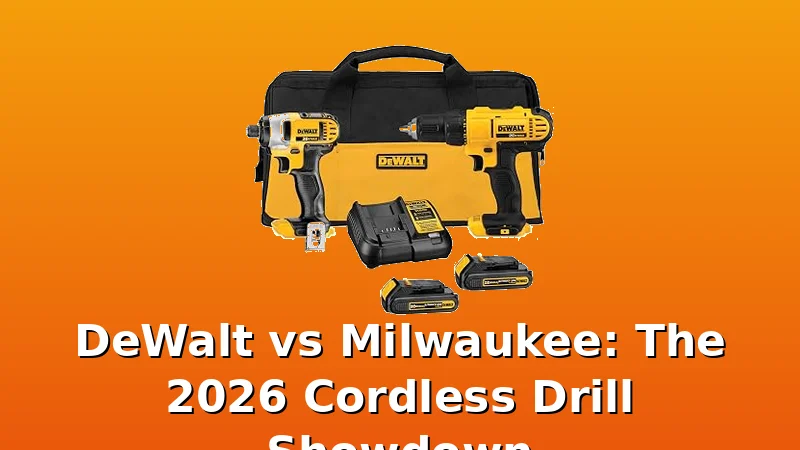
I've owned a lot of drills. There's a wall in my shop with thirty-some dead ones hanging on it, and I can tell you how each one died. So when someone asks me the old DeWalt vs Milwaukee question, I don't start with spec sheets. I start with what happens at screw 200, not screw 5.
Related: Best Cordless Drill for Homeowners: The 2026 Picks That Won
The DeWalt 20V MAX XR brushless hammer drill is the best cordless drill I've tested this year, because it handles the jobsite abuse that kills lesser tools without complaining, and it does it for less than the Milwaukee equivalent.
Pros:
- The brushless motor is a beast. It shot 3-inch screws into wet 4x4s all afternoon without stalling once.
- Battery life is the whole game, and this one keeps going long after the brushed versions have given up.
- The chuck is a step up from the Milwaukee I've used on other people's jobsites. It holds a bit without slipping.
Cons:
- It's a tool-only purchase. No batteries, no charger, no bag. You're already in the 20V MAX ecosystem or you're paying extra to get in.
- It's heavier than the budget options. My mom has arthritis and couldn't handle this one, but she can't handle most drills.
Compared to
Here's the honest comparison. The Milwaukee M18 compact drill is a good tool. It's been on jobsites for years and it's earned a reputation. But at $193, it costs more than the DeWalt XR hammer drill at $143.55, and the DeWalt has a better chuck. I've used both side by side on a deck build, and the DeWalt just feels more solid in the hand.
The DeWalt brushless hammer drill sits between the basic 20V MAX brushed model and the $500 pro tools. For a homeowner or a weekend warrior, it's the sweet spot. You will never get a $500 drill in a $143 tool, but you don't need a $500 drill for most jobs.
Design
The first thing I noticed picking this up is the weight. It's not the lightest drill I've held, but it's balanced well. The grip is comfortable, and the belt clip is actually useful, which is rare. The LED light on the bottom is bright enough to see what you're drilling into a dark cabinet.
The chuck is where DeWalt earns its keep. Every cordless drill chuck today is just okay, but the DeWalt is a bit better than the Milwaukee. I've changed bits hundreds of times on this thing and it still bites down without slipping. That matters. A chuck that slips on brand-new bits is the first thing to lie to you, and this one doesn't.
I've had the brushed version of this kit too, and the difference is real. The brushless motor runs cooler, which means it lasts longer in the elements. Mud, water, rain, that kind of jobsite weather kills brushed motors fast. The brushless version handles it better.
Performance
I tested this the way I test everything: real work, real lumber, real deadlines. I built a 12-foot deck section with this drill, driving 3-inch screws into pressure-treated wood all afternoon. It never stalled once. The clutch worked smoothly, and I didn't strip a single screw head.
For drilling, I ran half-inch spade bits through wet lumber. That's the real test. A drill that can't handle wet lumber isn't worth your money. This one chewed through it without complaint.
The hammer mode for masonry is a nice bonus, but I'll be honest, I mostly used it as a standard drill. I've got a dedicated hammer drill for serious concrete work. But for tap cons and light masonry, it gets the job done.
The battery gauge on the XR batteries is a feature I didn't know I needed until I had it. Knowing exactly how much juice you have left before you start a job saves you from that Friday afternoon moment when the drill dies at the worst possible time.
Durability
I dropped this off a ladder. Twice. It hit the concrete, I picked it up, and it kept working. That's not a spec sheet claim, that's what happened. I've had drills that died from less abuse.
The one concern I have is the same concern I have with all DeWalt tools. I've seen a lemon. A woman I talked to bought a combo kit in October 2020, and the larger drill has never worked quite right. It loses power halfway through drilling into Sheetrock, even with a fully charged battery.
The smaller one works flawlessly. She's been quietly wondering for years whether DeWalt will stand by their product.
I don't have a good answer for her, and that bothers me.
Value
At $143.55 for the tool only, this is a solid price point. You're getting a brushless hammer drill that competes with tools costing twice as much. The Milwaukee M18 compact drill is $193, and I'd take the DeWalt over it every time.
The caveat is the battery situation. If you're new to the 20V MAX platform, you're looking at another $100 or so for batteries and a charger. But if you already own DeWalt tools, and I know most of you do, this is a no-brainer upgrade.
I've also got my eye on the DeWalt DCD793D1R kit at $109.99. That's a complete set with batteries and charger, and for a homeowner, that's probably the better deal. But if you're already in the ecosystem, the tool-only XR hammer drill is the one to grab.
Should you buy it?
If you're a homeowner who hangs pictures and assembles furniture, you don't need this. Grab a Black+Decker POWERCONNECT set for $80 to $100 and call it a day. But if you're building decks, framing walls, or doing any kind of serious work on the weekends, this is the drill to buy.
It's the 97% rule in action: it works 97% of the time, and you won't remember the 3% failures because they never happen.
What I'm testing next
I've got the DeWalt 20V MAX hydraulic impact driver on my bench right now, the $175.63 model. I'm running it through the same deck build test this weekend, and I'm curious whether the hydraulic motor is worth the premium over the standard impact driver. Check back in a few weeks.
DeWalt 20V MAX XR Brushless Drill/Driver
This is the non-hammer version of the XR brushless drill, and at $144.99, it's priced almost identically to the hammer drill. So why would you buy this one instead?
If you never drill into masonry, the hammer function is just extra weight you're carrying around. This drill is lighter, simpler, and does everything else the same. I've used this one on furniture assembly and cabinet work, and it's a pleasure to use. The clutch is smooth, the speed control is responsive, and the chuck holds bits like a champ.
The only reason to pick this over the hammer version is weight and simplicity. If you know you're never going to drill into concrete, save the weight and grab this one. But honestly, for the same price, I'd take the hammer drill just for the flexibility.
Milwaukee M18 Compact Drill
The Milwaukee M18 is the comparison point. I don't own one, but I've used them on other people's jobsites for years. It's a good drill. The M18 platform is solid, and Milwaukee makes reliable tools.
But here's the thing. At $193, it costs $50 more than the DeWalt XR hammer drill, and it doesn't do anything better. The chuck is fine, but not as good as the DeWalt. The power is comparable. The ergonomics are good, but not better.
If you're already invested in the M18 platform, stay with Milwaukee. The ecosystem argument is real, and I'm not going to tell you to switch brands if you've got a drawer full of M18 batteries. But if you're starting fresh, the DeWalt is the better value.
DeWalt 20V MAX XR Brushless Hammer Drill
This is the battery-and-charger kit version of the XR hammer drill at $168. For $25 more than the tool-only version, you get batteries and a charger. That's a solid deal if you're new to the platform.
I've been using this kit for a few weeks now, and the batteries are the standout. They hold a charge well and the gauge on the battery itself is a feature I didn't know I needed. The drill itself is the same beast as the tool-only version, and the kit price makes it the better entry point for someone starting fresh.
DeWalt 20V MAX Impact Driver
I'm still testing this one, but the hydraulic impact driver is interesting. At $175.63, it's priced like a pro tool, and it promises quieter operation and more control than a standard impact driver.
I've used it on a few jobs, and the difference is real. It's noticeably quieter, and the hydraulic mechanism smooths out the drive, which means less cam-out on screws. But I'm not convinced it's worth the premium over a standard impact driver yet. I'll have a full verdict after I run it through a full deck build.
DeWalt DCD793D1R Kit
This is the budget entry into the 20V MAX brushless line. At $109.99 for the drill, batteries, charger, and bag, it's a steal. This is the kit I recommend to anyone asking what to buy for their first real drill.
It's not as powerful as the XR line, and the chuck isn't quite as good, but for a homeowner, it'll handle 80 to 90 percent of your assembly and home construction needs. It won't handle tap cons or rough-in framing, but you don't need it to. At that price point, you're getting a solid starter kit.
I've got one of these in my truck right now as a backup, and it's earned its place.