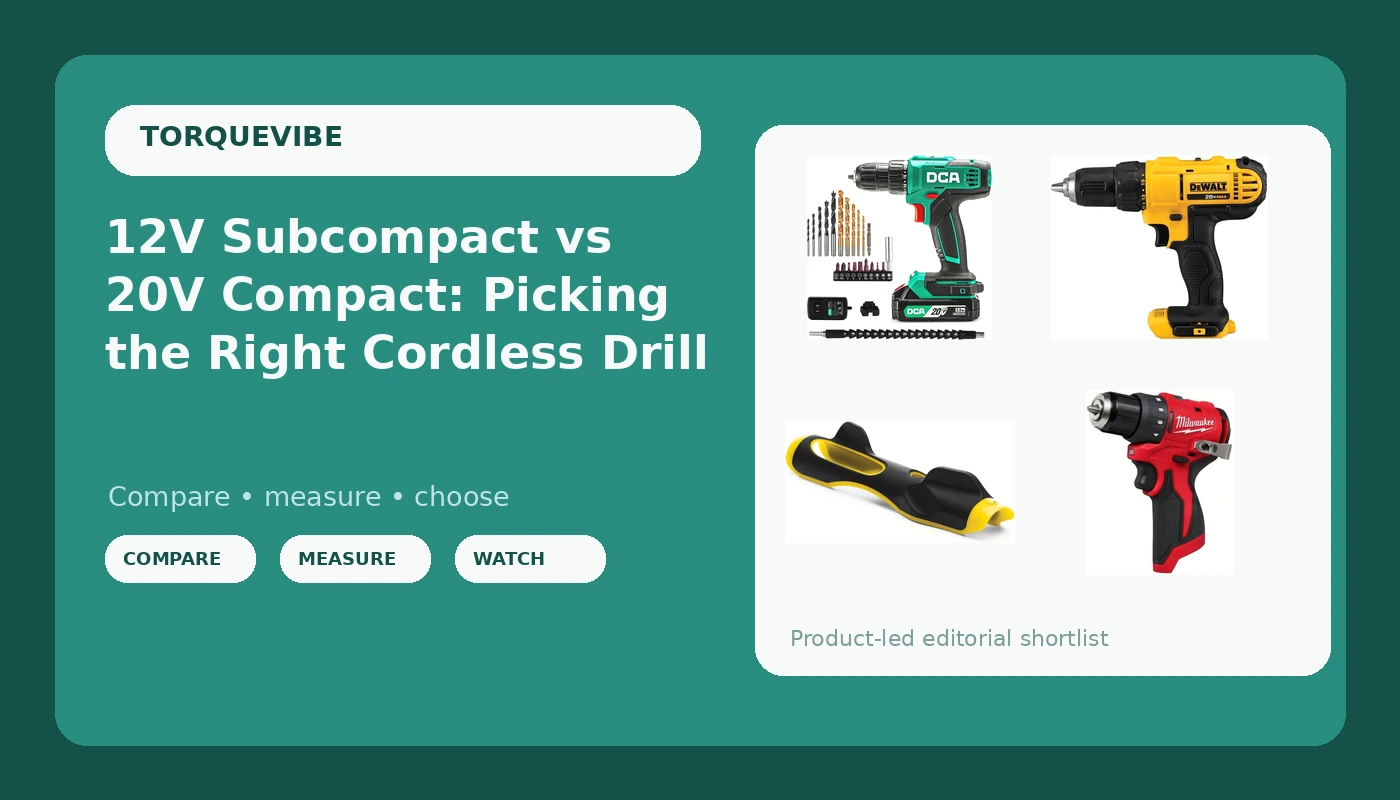
The cordless drill and driver aisle is where a lot of tool money goes wrong, and it is almost never the motor's fault. It is the battery. You buy a drill because it is cheap that week, you use it for two years, and then the platform gets discontinued, replacement packs cost more than the tool did, and the chuck starts slipping on brand-new bits. Nothing on the box warned you about any of that. What follows is a plain walkthrough of what the listings actually tell you, where a 12V subcompact brushless drill/driver differs from a 20V kit with a battery and charger, and where a bare tool fits, so you can match the purchase to the work instead of to the sticker.
Related: Battery Platform Longevity: Why the Drill Is the Cheap Part →
Quick answer
Buy the battery platform first and the drill second. A 12V subcompact brushless drill/driver suits overhead work, cabinet interiors, and tight spaces where a lighter tool gets picked up more often. A 20V kit that includes a battery, a charger, and a bit set is the sensible start when you own nothing. A bare-tool 20V compact drill/driver only makes sense if you already have batteries and a charger for that platform. And one listing in this set is a golf training aid, not a drill, so read the product name before you click.
4 useful options
| Model | Best fit | What stands out |
|---|---|---|
| Milwaukee Electric - M12 SUBCOMPACT BRUSHLESS 3/8 Drill/Driver,12V | Overhead work, cabinets, tight spaces | A 12V subcompact class drill/driver with a brushless motor and a 3/8 inch chuck |
| DCA Cordless Drill Set, 354 in-lbs Torque, 3/8" Keyless Chuck, Electric Power Drill with 2.0Ah Battery and Charger,18+1 Position,25-Piece 20V Drill Driver Kit, ADJZ2035 | Starting from zero | Listed 354 in-lbs of torque, an 18+1 position clutch, and a 2.0Ah battery, charger, and 25-piece kit in the box |
| Dewalt DCD771B 20V MAX Cordless Lithium-Ion 1/2 inch Compact Drill Driver - Bare Tool | Buyers already on the 20V MAX platform | A 1/2 inch compact drill/driver sold as a bare tool, so no battery or charger is included |
| SKLZ Golf Grip Trainer, Club Attachment for Correct Hand Positioning and Muscle Memory, Fits Standard Grips from Driver to Wedge, Right-Handed, Compact Training Aid for Practice and Pre-Round Warm-Up | Golf practice, not drilling | A club attachment training aid for hand positioning, right-handed, sized for standard grips from driver to wedge |
The subcompact brushless route: Milwaukee M12
The trade-off with any 12V subcompact is honest and predictable. A 3/8 inch chuck takes bits with a 3/8 inch shank and nothing larger, so a 1/2 inch shank spade bit or hole saw is out. The smaller battery class also means fewer fasteners per charge than a 20V pack, and a 12V battery will not run 20V tools in the same family. What you get back is a tool you can hold at arm's length all afternoon without your wrist filing a complaint. If most of your work is assembly, cabinets, and small fasteners, that trade is a good one. If most of your work is framing, it is not.
The complete kit route: DCA Cordless Drill Set
Kits are the lowest-friction way to start, and they are also where buyers stop reading. A 2.0Ah battery is a small pack, which means lighter weight and shorter runtime than a larger pack on the same tool. The 18+1 clutch is the part that matters most for finish work: setting the collar low lets the clutch slip instead of burying a screw through drywall. The question a kit cannot answer for you is what else runs on that battery. Before you commit to any 20V platform, look at the rest of the lineup, because the batteries will outlive this drill.
The bare-tool route: DeWalt DCD771B
The bare-tool math only works one way. Add up the drill plus a battery plus a charger and compare that against a kit that includes all three, then decide. The 1/2 inch chuck is the real draw here: it accepts the larger shank bits that a 3/8 inch chuck turns away, which matters for spade bits and hole saws. A bare tool is also how a shop ends up with four chargers and three orphaned batteries, so buy it deliberately, not because the listing looked cheaper at a glance.
The listing that is not a drill: SKLZ Golf Grip Trainer
If you came here shopping for a drill, skip this one. It is worth naming out loud because mixed search results are how people end up with the wrong item in the cart, and because a grip trainer is a legitimate purchase for a different reader entirely: the golfer in the house who wants to work on hand position without hitting balls. Treat it as a separate decision with its own budget, not as part of a drill comparison.
Prices and availability may change. Product images, names, and retailer links are matched to verified listings. No current price, rating, stock status, or measured result is stated here without current evidence.
What voltage actually buys you
Voltage is a rough proxy for battery pack size and motor class, not a promise about torque. A 12V subcompact and a 20V compact can both drive a 2 inch screw into pine; they will not feel the same doing it, and they will not run as long. The numbers that matter more than voltage are on the listing itself. Listed torque in in-lbs tells you what the manufacturer claims, and it is always measured under favorable conditions, so treat it as a ceiling rather than a floor. Chuck size tells you what bits the tool will physically accept: 3/8 inch is the common compact size, 1/2 inch opens the door to larger shanks. Clutch positions tell you how finely you can dial down driving force, which is the difference between a screw set flush and a screw punched through drywall.
The other distinction worth keeping straight is drill versus impact driver. A drill/driver turns continuously and uses a clutch to limit torque. An impact driver delivers rotational blows and uses a 1/4 inch hex collet instead of a chuck. For long deck screws and repetitive driving, the impact driver is the correct tool and the drill is the wrong one. For holes and for controlled driving into soft material, the drill/driver wins. Buying one tool to do both jobs is how people burn up motors.
How to read a drill listing before you buy
- Check whether a battery and charger are included. "Bare tool" means they are not, and that changes the real cost.
- Check the chuck size and type. 3/8 inch versus 1/2 inch decides which bits you can use, and keyless means no chuck key to lose.
- Read the listed torque and clutch positions as manufacturer claims, not as measurements of your work.
- Identify the battery platform and look at what else runs on it. Batteries outlive drills, so the platform is the long commitment.
- Confirm the kit contents, including bits, case, and charger, so you know what it takes to get working on day one.
Matching the tool to the job
- Overhead work, cabinet interiors, and small fasteners: a 12V subcompact drill/driver keeps the weight down and gets used more.
- Starting from zero with no batteries at all: a kit with a battery, charger, and bit set avoids a second purchase.
- Already invested in a 20V platform: a bare tool adds capability without another charger.
- Long deck screws and repetitive driving: reach for an impact driver with a hex collet, not a drill.
- Large holes and bigger shank bits: a 1/2 inch chuck is the minimum, and a corded or higher-torque tool may be the better answer.
Which option should you choose?
Choose the Milwaukee Electric - M12 SUBCOMPACT BRUSHLESS 3/8 Drill/Driver,12V when most of your work is overhead, indoors, or in tight spaces and you want a light tool with a brushless motor. Choose the DCA Cordless Drill Set when you are starting from nothing and want a battery, charger, and bits in one purchase. Choose the Dewalt DCD771B 20V MAX Cordless Lithium-Ion 1/2 inch Compact Drill Driver - Bare Tool when you already own 20V MAX batteries and a charger and want the larger 1/2 inch chuck. The SKLZ Golf Grip Trainer is a separate decision for a golfer working on hand position, not a drill at all.
One caveat applies to all of them. Listings change, kit contents change, and a product name is not a specification sheet. Verify the included items, the chuck size, and the battery platform on the listing itself before you buy, and do not assume two listings that look similar are the same package.
The bottom line
The drill is the cheap part. The battery platform is the purchase you live with, which is why the sensible order is platform first, tool second, accessories last. A 12V subcompact brushless drill/driver earns its place through size and control, a 20V kit earns it by getting you working in one purchase, and a bare tool earns it only when the batteries are already on your shelf. Read the listing carefully enough to know which of those three you are actually buying, and check the current Amazon price against the full cost of a working setup before you commit.