Standing in front of a shelf of 20V cordless drill drivers, every box looks the same. Same voltage, same 1/2-inch chuck claim, same photo of a guy in safety glasses. What the boxes do not tell you is that the voltage label is the least useful number on them. A 20V cordless drill driver is really three decisions bundled together: which battery platform you are marrying into, what kind of motor is inside the housing, and whether the chuck will still bite after a few hundred bit changes. Get those right and the drill itself is almost an afterthought. Get them wrong and you will be shopping again in eighteen months, which is the most expensive way to buy a drill.
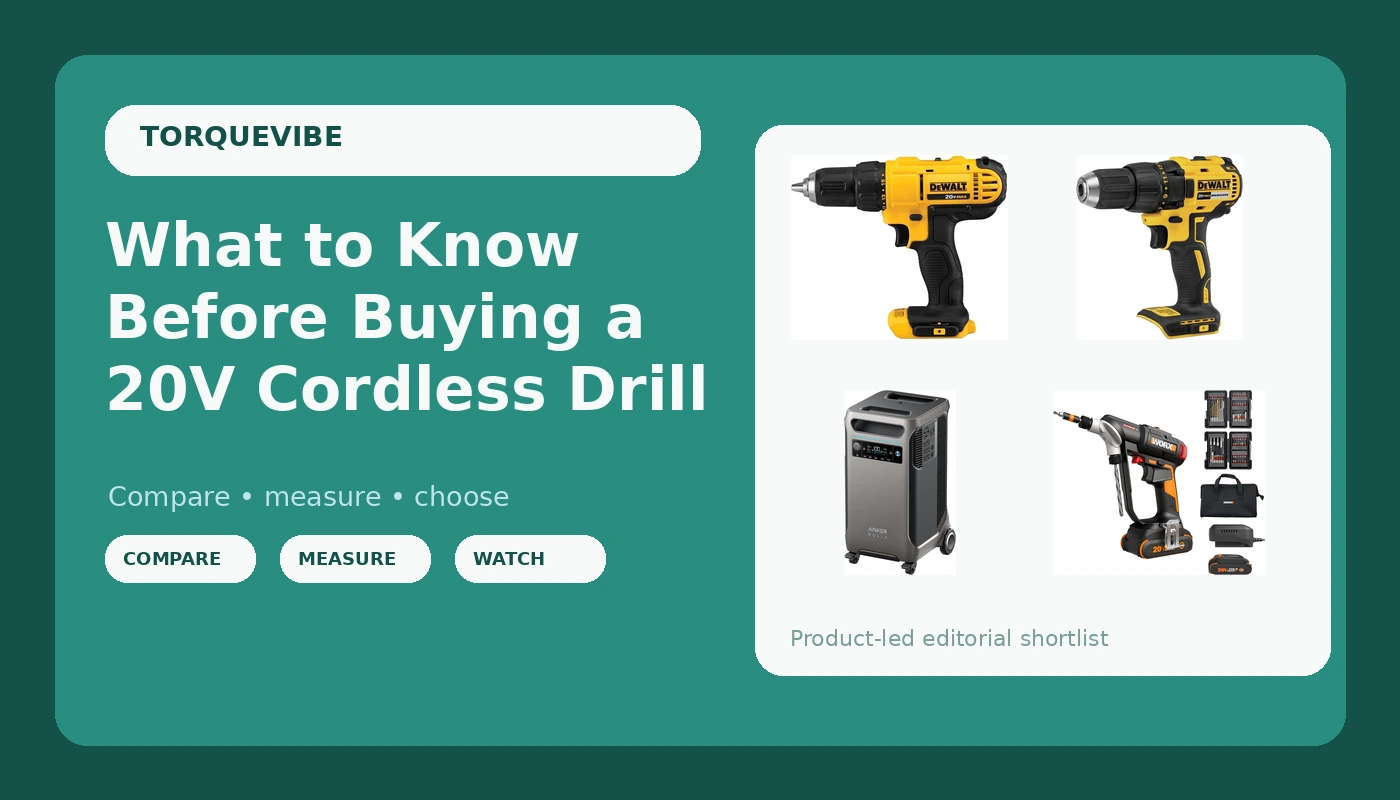
This explainer walks through the four tools in this roundup: two DEWALT 20V drills that share one battery family, a brushless two-in-one WORX driver, and a large portable power station for the days when the nearest outlet is a hundred feet away and behind a locked door.
Related: Brushless vs Brushed Drills: What the Motor Actually Changes →
Quick answer
Decide the battery platform before you decide the drill. If you already own DEWALT 20V MAX batteries and a charger, the DCD777B is the 1/2-inch drill-driver to add, and the DCD771B is the lower-cost compact option inside that same battery family. If you want one tool that can hold a drill bit and a driver bit at the same time, the WORX SwitchDriver is the only tool here built that way, and it is brushless. If the real problem is not the drill but the power, the Anker SOLIX F3800 is the piece that runs chargers and corded tools where there is no grid. The three drills here are sold tool-only, so read the listing to confirm exactly what is in the box; the power station is a complete unit listed as renewed.
Four useful options
| Model | Best fit | What stands out |
|---|---|---|
| DEWALT 20V MAX Cordless Drill, 1/2-Inch, Tool Only (DCD777B) | Someone already on the DEWALT 20V MAX platform | 1/2-inch cordless drill-driver sold as a tool-only listing |
| Dewalt DCD771B 20V MAX Cordless Lithium-Ion 1/2 inch Compact Drill Driver - Bare Tool | Lowest-cost entry into the same battery family | Compact 1/2-inch drill-driver, bare tool |
| WORX Cordless Drill Driver, 20V Brushless, SwitchDriver 2-in-1, WX177L.2 | Drilling and driving in the same minute | 20V brushless motor with a two-in-one SwitchDriver design |
| Anker SOLIX F3800 Portable Power Station, 3840Wh, LiFePO4 Batteries, Ultra-High 6000W AC Output with 120V/240V, Solar Generator for Home Backup and Outdoor Camping (Renewed) | Jobsite power and home backup | 3,840Wh LiFePO4 capacity, 6,000W AC output, 120V and 240V |
The drill to start with: DEWALT 20V MAX Cordless Drill, 1/2-Inch, Tool Only (DCD777B)
The trade-off with any tool-only listing is obvious once you say it out loud: if you are not already on that platform, the drill is not the whole purchase. You are buying a battery, a charger, and then every tool after that. That is not a downside if you plan to stay in one family for the next decade, and it is a real cost if you do not. The 1/2-inch chuck is the part that keeps this drill useful for general work, since it accepts the round-shank bits most people actually own rather than hex-shank bits only.
The budget entry: Dewalt DCD771B 20V MAX Cordless Lithium-Ion 1/2 inch Compact Drill Driver - Bare Tool
Wait. That link is wrong. Correct: https://www.amazon.com/dp/B013PK7TM8?tag=audiointerf06-20
Compact drills are where most people should start, and they are also where most people get frustrated, because a compact drill is not an impact driver and it is not a hammer drill. It drives screws, it bores holes with the right bit, and it does it in tight spaces. Ask it to sink three-inch deck screws all afternoon and you will smell the motor before the job is done. That is not a flaw in this tool; it is a category limit that applies to every compact drill on the market, including the expensive ones.
The two-in-one: WORX Cordless Drill Driver, 20V Brushless, SwitchDriver 2-in-1, WX177L.2
The honest trade-off is the platform. Buying this tool means buying into the WORX 20V battery family rather than the DEWALT one, and the battery system is the real purchase. That is fine if you are starting fresh or you want a second family for around the house. It is a poor idea if you are trying to consolidate onto one charger and one stack of batteries for everything you own. The brushless part is not marketing, though. A brushless motor removes the carbon brushes that are the usual failure point in a cheaper drill, and that is the difference between a tool that lasts a season and one that lasts a decade.
The power: Anker SOLIX F3800 Portable Power Station, 3840Wh, LiFePO4 Batteries, Ultra-High 6000W AC Output with 120V/240V, Solar Generator for Home Backup and Outdoor Camping (Renewed)
Two things need saying plainly. First, a power station is not a battery charger for your drill platform unless the listing says it can be used that way, so plan on charging drill batteries from the wall and using the station for corded tools, lights, and whatever else you would normally plug in. Second, the renewed label is not a defect label, but it does mean the unit is not factory-new, and the specific condition, included accessories, and warranty are set by the seller rather than by you. Read that listing carefully before you commit, because a power station is a bigger check than any drill here.
Prices and availability may change. Product images, names, and retailer links are matched to verified listings. No current price, rating, stock status, or measured result is stated here without current evidence.
What the voltage number does and does not tell you
Every drill on this list is labeled 20V, and that label tells you almost nothing about which one will suit you. Voltage is a nominal platform figure, not a power rating. What actually separates these tools is the motor design, the chuck, and the battery family behind them.
Motor design comes first because it decides how long the tool lives. Brushed motors use carbon brushes that wear down as they spin, and those brushes are the classic failure point on a cheap drill. Brushless motors remove them entirely, which is why brushless tools generally run longer per charge and survive more years of use. That is the single biggest fork in the road, and it is not visible on the front of the box.
The chuck comes second. A 1/2-inch chuck accepts the round-shank bits most people already own, which makes a drill useful for general work rather than only for hex-shank accessories. A chuck that slips under load is a tool that lies to you, no matter what the box claims, and there is no spec sheet number that captures it.
Battery family comes third, and it is the longest-lasting decision. A drill is one tool on a platform. Batteries, chargers, and every tool you buy for the next ten years all hang off the same choice, so the platform matters more than the drill you happen to be holding today.
The order to make the decision in
- Pick the battery platform you intend to stay on, based on the tools you already own or plan to own.
- Decide brushed or brushless. Brushless costs more up front and usually pays that back in runtime and lifespan.
- Decide whether you need a 1/2-inch chuck or whether a compact body matters more for the work you do.
- Decide between a bare tool and a kit. A bare tool is cheaper only if you already own the battery and charger.
- Decide whether you need on-site power. If there is no outlet, budget for that separately instead of assuming a bigger drill solves it.
Keeping a drill and a power source working on site
- Keep at least two batteries in rotation so one is always charged and cool.
- Set the clutch collar so the drill stops spinning at a set torque instead of burying screws through drywall.
- Do not use a drill as an impact driver. Long deck screws and lag bolts want an impact tool, not a drill chuck.
- Store batteries at room temperature and charge them before they are fully dead, not after.
- If you work without grid power, size the power station to the tools you actually run, and keep the drill batteries on a wall charger at home base.
Which option should you choose?
Choose the DEWALT 20V MAX Cordless Drill, 1/2-Inch, Tool Only (DCD777B) when you are already on the DEWALT 20V MAX platform and want a straightforward 1/2-inch drill-driver to add to it. Choose the Dewalt DCD771B 20V MAX Cordless Lithium-Ion 1/2 inch Compact Drill Driver - Bare Tool when you want the lowest-cost way into that same battery family and the work is general drilling and driving rather than heavy fastening. Choose the WORX Cordless Drill Driver, 20V Brushless, SwitchDriver 2-in-1, WX177L.2 when you are starting fresh on a battery platform and the constant bit swapping is what slows you down. Choose the Anker SOLIX F3800 Portable Power Station when the constraint is not the tool at all, but the absence of an outlet.
The caveat is that none of these choices is settled by a spec sheet. Battery condition, chuck wear, and how hard you actually push a compact drill all show up in use, not in a number on a box, so treat the platform decision as the one you have to get right and the rest as adjustable.
The bottom line
The drill is the cheap part of this decision and the battery platform is the expensive one. If you already own DEWALT 20V MAX batteries, the DCD777B is the 1/2-inch drill to add, and the DCD771B is the compact, lower-cost entry into the same family. If you are building a platform from zero and want one tool that handles drilling and driving without a bit change, the WORX SwitchDriver is built for exactly that, and its brushless motor removes the wear point that kills cheap drills. And if the job has no outlet, the Anker SOLIX F3800 addresses the problem that no drill can solve on its own. Buy the platform first, the motor second, and the drill third.