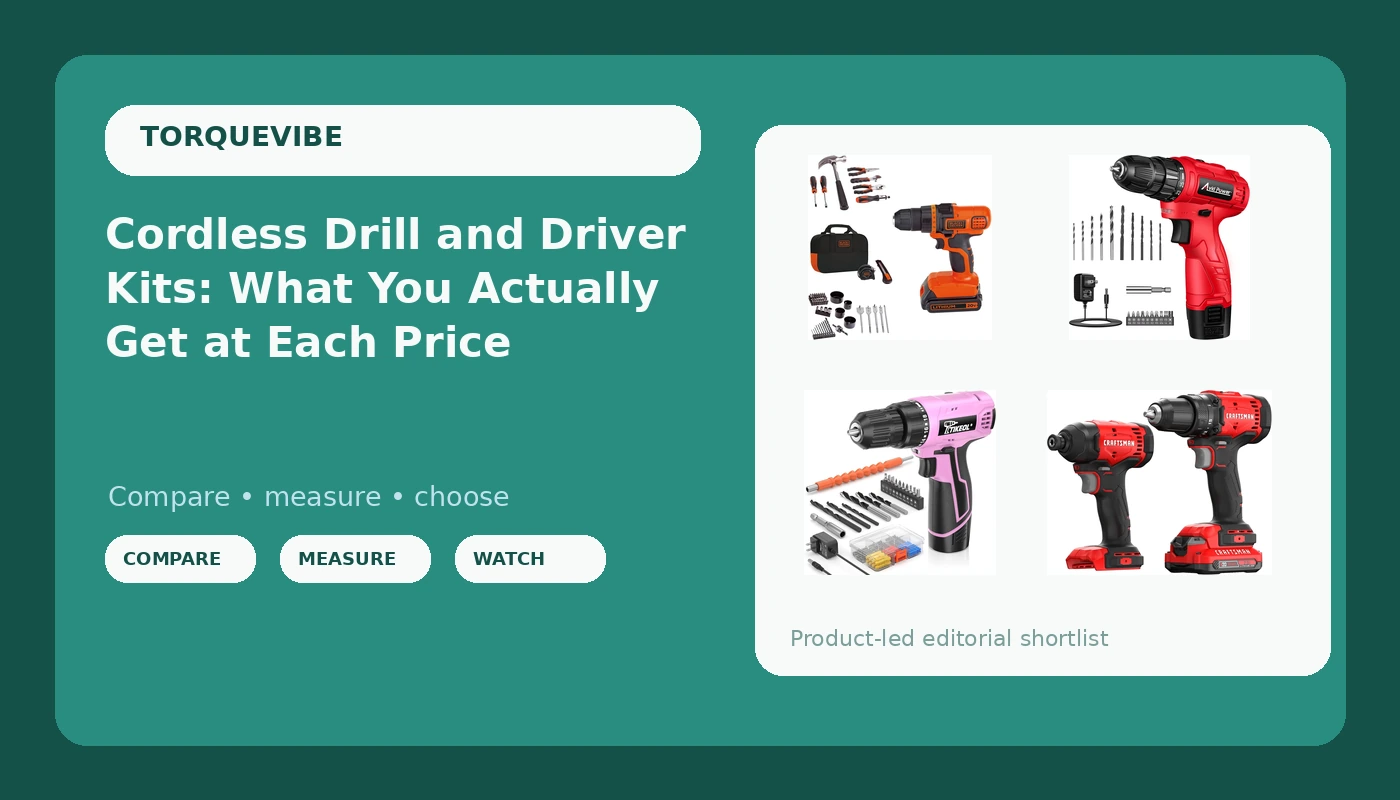
A cordless drill is usually the first power tool anybody buys, and the cordless drill and driver kits in this guide sit at four different points on the ladder, from a small 12-volt set to a two-tool 20-volt kit with an impact driver in the box. The question I hear most from homeowners and new apprentices is always the same: what does the extra money actually buy?
Sometimes it buys a better motor. Sometimes it buys a bigger battery. Sometimes it buys a second tool, and sometimes it just buys a nicer bag and sixty bits you will never touch. Here is what I tell anybody who asks. The drill is the cheap part. The battery platform is the purchase. A 12-volt tool that shares batteries with nothing else becomes a paperweight the day the charger quits, while a 20-volt kit that plugs into a whole family of tools can stay useful for a decade. Everything below is about that math, plus the specs that actually change how a drill feels in your hand: chuck size, clutch settings, motor type, and whether the bits in the box are the ones you will really use.
Related: Battery Platforms Explained: Why the Drill Is the Cheap Part →
Quick answer
Match the kit to the work you have, not to the biggest number on the box. A 12-volt drill with a 3/8-inch chuck and a clutch covers furniture assembly, hanging shelves, and pilot holes in softwood. If your list includes deck screws, lag bolts, or repeated work in hardwood, step up to a 20-volt kit, and if fastening is most of the job, get one that includes an impact driver, because a drill asked to be a screwdriver all day is always a compromise.
Four useful options
| Model | Best fit | What stands out |
|---|---|---|
| BLACK+DECKER 20V MAX 68-Piece Cordless Drill and Home Tool Project Kit with Tool Storage Bag (LDX120PK) | Households starting a tool collection | 20V MAX drill bundled with a 68-piece project kit and a storage bag |
| AVID POWER 12V Cordless Drill Set 3/8" Power Driver, 21 Bits for DIY-Red | Small repairs and tight spaces | 12V driver with a 3/8-inch chuck and 21 included bits |
| 12V Cordless Drill Set with Battery & Charger, Electric Power Drill with Pure Copper Motor, 180 In-lbs Torque, 18+1 Clutch, 3/8" Keyless Chuck, LED Light, Drill Kit for Home Repair, DIY(Pink) | A first drill for light home repair | Listed 180 in-lbs torque, 18+1 clutch, keyless chuck, LED light |
| CRAFTSMAN V20 Cordless Drill Set and Impact Driver, Includes 2Ah Battery and Charger, Power Tool Set with 1700 RPM 1/2 In. Power Drill, 1800 Torque 1/4 In. Impact Screwdriver, LED (CMCK201D1) | Drilling plus a lot of fastening | Drill and impact driver, 2Ah battery and charger, listed 1700 RPM drill |
The all-in-one starter kit: BLACK+DECKER 20V MAX 68-Piece Cordless Drill and Home Tool Project Kit with Tool Storage Bag (LDX120PK)
The pitch here is simple: one purchase, one battery, one bag, and enough bits and drivers to hang a gallery wall or assemble a house full of flat-pack furniture. For a first drill, that removes a lot of decisions, and the 20V MAX name means the tool belongs to a battery family rather than standing alone, which is the part that matters five years from now. The trade-off is that a kit built around household projects is a starting point, not a professional loadout. If you already own a decent bit set, a good chunk of the accessory count is duplication you are paying for.
The compact 12-volt: AVID POWER 12V Cordless Drill Set 3/8" Power Driver, 21 Bits for DIY-Red
Twelve-volt tools get dismissed as toys, and that is usually wrong. The real difference between 12 volts and 20 volts is not whether the drill turns, it is how hard you can lean on it before it stalls and how many holes you get per charge. For cabinet hardware, curtain rods, outlet plates, and furniture assembly, a light 12-volt driver is often the more pleasant tool because it weighs less and reaches where a full-size drill will not. The 3/8-inch chuck is the limit worth understanding: it will not hold the big shank bits, so this is not the tool for boring through a stud with a spade bit.
The light-duty budget pick: 12V Cordless Drill Set with Battery & Charger, Electric Power Drill with Pure Copper Motor, 180 In-lbs Torque, 18+1 Clutch, 3/8" Keyless Chuck, LED Light, Drill Kit for Home Repair, DIY(Pink)
This is the kind of kit that makes sense for one job and a drawer: a first drill for an apartment, a drill that lives in a kitchen cabinet, or a gift for somebody who has never owned one. A listed 180 in-lbs of torque is honest small-tool territory, which means it drives screws into softwood and anchors into drywall without drama, and it will bog down on anything much bigger. That is a category difference, not a defect. The 18+1 clutch is the feature worth caring about, because it stops the chuck from spinning at a set point so you do not bury a screw through drywall or strip out a furniture screw head.
The two-tool step up: CRAFTSMAN V20 Cordless Drill Set and Impact Driver, Includes 2Ah Battery and Charger, Power Tool Set with 1700 RPM 1/2 In. Power Drill, 1800 Torque 1/4 In. Impact Screwdriver, LED (CMCK201D1)
This is the configuration I would point most people toward once their work goes past picture frames, because the impact driver is the tool that actually solves the deck screw problem. An impact driver delivers rotational blows instead of steady twist, which is why it drives long screws without the cam-out and wrist torque you fight with a drill. The 1/2-inch chuck on the drill side is a genuine step up from 3/8-inch, since it holds larger bits and hole saws. Two cautions. The listed impact figure of 1,800 does not name its units, so treat it as a relative number rather than something to compare across brands. And V20 is a battery family, so if you plan to add tools, check what else that platform covers and how easy replacement batteries are to find.
Prices and availability may change. Product images, names, and retailer links are matched to verified listings. No current price, rating, stock status, or measured result is stated here without current evidence.
What torque ratings actually tell you
Inch-pounds are the unit you will see on almost every drill box, and they are the most misunderstood number in the aisle. A torque figure describes how much twisting force the tool can produce at the chuck, and it is usually measured on a fresh battery with a warm motor, in conditions no jobsite has ever reproduced. What matters more is what the tool does once the battery has run down a bit and your arm is tired. A drill rated at a few hundred inch-pounds will still sink a screw into pine on its tenth hole; it will not enjoy a three-inch deck screw in wet lumber, and no rating fixes that.
This is why the drill versus impact driver distinction matters more than any single spec. A drill is built to make round holes, and its clutch and gearing are set up around that job. An impact driver is built to turn fasteners, and it converts motor power into rotational impacts so the screw keeps moving without the tool trying to twist your wrist off. A drill with a high torque number is not a substitute for an impact driver, and an impact driver with a 1/4-inch hex collet is not a substitute for a drill with a chuck. If your project list is mostly screws, buy the tool built for screws.
Chuck, clutch, and motor: the specs that decide how a drill feels
The chuck is the three-jaw grip that holds the bit, and its size sets your ceiling. A 3/8-inch chuck takes the common twist bits, driver bits, and small hole saws, which is everything a household drill needs. A 1/2-inch chuck takes larger shanks, bigger hole saws, and the bits you need for real framing and plumbing work. Keyless chucks let you tighten by hand, which is convenient, and the honest test of any chuck is whether it still bites after a few hundred bit changes. A slipping chuck is a lying tool, and no spec sheet will warn you about it.
The clutch is the adjustable collar that slips at a set torque so the drill stops turning the bit. On a drill with an 18+1 clutch you get 18 driving settings plus one drill mode, and those settings are what keep you from driving a screw straight through drywall or crushing a cabinet hinge. Then there is the motor. Brushed motors use carbon brushes that wear out, and brushless motors do not, which is the difference between a tool that survives a season of hard use and one that survives a decade. If a listing does not say brushless, assume it is not.
Here is the order I would work through it:
- Write down the five jobs you actually have, not the ones you imagine.
- Match voltage to the work: 12 volts for assembly and light repair, 20 volts for building and repeated drilling.
- Check the chuck size, because 3/8-inch and 1/2-inch take different bits.
- Count the clutch settings, since that is what controls screw depth.
- Look at the battery family before the drill, because you are buying into the platform.
How to buy a drill kit without wasting money
- Buy the platform first. A drill whose batteries are discontinued is scrap, no matter how good the drill is.
- Ignore the bit count on the box. Twenty-one bits and sixty-eight bits usually means the same five sizes plus filler.
- Budget for a second battery before you need one, because a single 2Ah pack will not carry a full afternoon of drilling.
- Decide between 3/8-inch and 1/2-inch chuck based on the largest bit you will ever use, not the smallest.
- Prioritize the clutch and the chuck over the torque claim. Those two are what you touch on every single screw.
Which option should you choose?
Choose the BLACK+DECKER 20V MAX 68-Piece Cordless Drill and Home Tool Project Kit with Tool Storage Bag (LDX120PK) when you want one box that covers household projects and a battery family to grow into. Choose the AVID POWER 12V Cordless Drill Set 3/8" Power Driver, 21 Bits for DIY-Red when your work is light, occasional, and often in tight spaces. Choose the 12V Cordless Drill Set with Battery & Charger, Electric Power Drill with Pure Copper Motor, 180 In-lbs Torque, 18+1 Clutch, 3/8" Keyless Chuck, LED Light, Drill Kit for Home Repair, DIY(Pink) when you want a small, self-contained kit with a clutch and charger included for the lowest outlay. Choose the CRAFTSMAN V20 Cordless Drill Set and Impact Driver, Includes 2Ah Battery and Charger, Power Tool Set with 1700 RPM 1/2 In. Power Drill, 1800 Torque 1/4 In. Impact Screwdriver, LED (CMCK201D1) when screws are most of the job and you want a drill and an impact driver on the same battery.
None of that is a durability verdict. The listings tell you what is in the box, the chuck size, and the voltage, and those are the facts you can compare. Runtime, motor life, and how a chuck holds up after a few hundred bit changes are things only time on the job will show, and no product page can tell you.
The bottom line
The right kit depends on the work in front of you. If you are assembling furniture and hanging shelves, a 12-volt kit with a clutch, a keyless chuck, and a charger in the box is enough tool, and the pink 12V kit lays those features out plainly. If you want one purchase that covers household projects and gives you a battery family to build on, the BLACK+DECKER 20V MAX kit is the all-in-one answer. If you need something compact for small repairs, the AVID POWER 12V set fits that role. And if your projects involve real fastening, the CRAFTSMAN V20 drill and impact driver set puts the right tool for screws in the same box as the right tool for holes. Check current listings before you buy, and remember that the battery platform is the part you live with longest.