Walk down the power tool aisle of any hardware store in the Midwest and the boxes start to blur together. Voltage numbers climb, piece counts get longer, and the word pro shows up on tools that would not survive a Tuesday on a real jobsite. Here is the thing nobody puts on the packaging: a cordless drill and driver kit is not one purchase. It is a battery platform, a chuck, a clutch, and a decision about whether you want a drill alone or a drill plus an impact driver. Get those things right and the tool is still earning its keep in ten years. Get them wrong and you are back at the store in a season, fighting a chuck that slips and a battery that will not hold a charge.
This explainer covers four different answers to the same question. One all-in-one home kit, one compact 12V set, one two-tool drill and impact driver combo, and one small accessory that fixes a problem nearly every drill owner runs into. No spec sheet worship, no invented test numbers, just what the figures on the box do and do not tell you.
Related: How to Set a Drill Clutch So You Stop Stripping Screws →
Quick answer
For most homeowners doing repairs, hanging shelves, and assembling furniture, a 20V drill driver kit with a bit set and charger covers nearly everything. If you drive a lot of screws, a set that includes both a drill and a dedicated impact driver earns its keep, because the impact driver does the fastening while the drill keeps a bit free for holes. A compact 12V drill fits light work and tight spaces better than a full-size tool. And if your problem is holes that start crooked in round stock, a self-centering drill guide solves it in a way no drill upgrade can.
Four useful options
| Model | Best fit | What stands out |
|---|---|---|
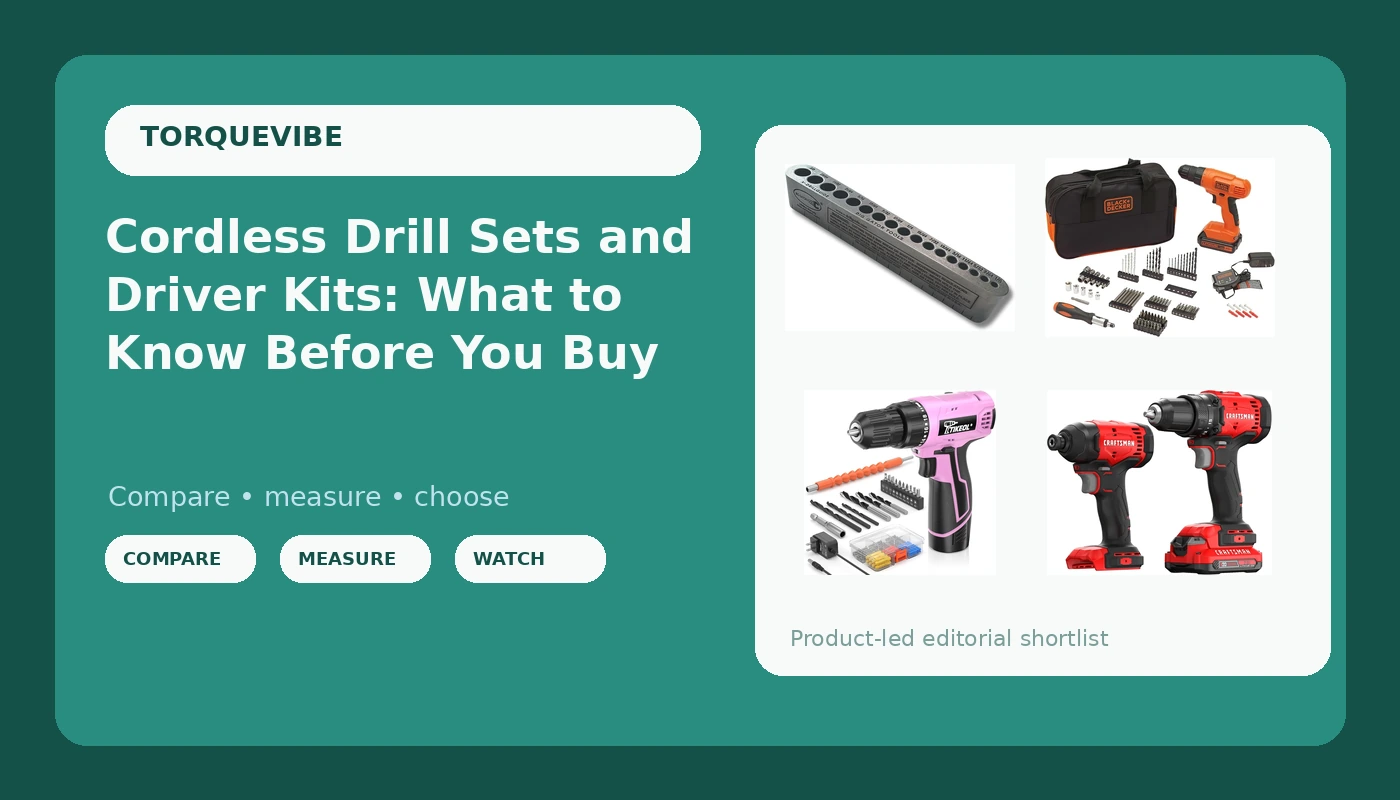
| BLACK+DECKER 20V MAX POWERCONNECT Cordless Drill Driver Kit with Drill Bit Set and Sockets, 100 pc. (BDC120VA100) | General home drilling and driving | 20V MAX POWERCONNECT battery and charger, plus a 100 piece bit and socket kit in the box |
| 12V Cordless Drill Set with Battery & Charger (Pink) | Light duty work and tight spaces | 180 in-lbs torque, 18+1 clutch, 3/8 inch keyless chuck, LED light |
| CRAFTSMAN V20 Cordless Drill Set and Impact Driver (CMCK201D1) | Projects with a lot of screws | 1700 RPM 1/2 inch drill plus a 1/4 inch impact driver, 2Ah battery and charger |
| Big Gator Tools The Original V-Drill Guide STD1000DGNP | Straight holes in round stock | V-shaped guide sized for bits from 1/8 to 3/8 inch |
The all-in-one home kit: BLACK+DECKER 20V MAX POWERCONNECT Cordless Drill Driver Kit
The value here is not the drill, it is the whole box. Buying a drill and then buying bits, drivers, and sockets separately usually costs more than the kit does, and the accessories are the parts you reach for every single time. The trade-off is that this is homeowner-duty equipment. It is built for shelves, furniture, curtain rods, and light repair, not for a full day of driving structural screws. That is a fair trade as long as you know which one you are buying.
The light-duty compact: 12V Cordless Drill Set with Battery & Charger (Pink)
A 12V drill has a narrow lane and it is a useful one. For pilot holes in pine, driving small screws into softwood, assembling flat-pack furniture, and working inside a cabinet where a full-size drill will not fit, a compact tool is easier to control and easier on your wrist. What it will not do is drive long fasteners into hard lumber all afternoon, and no clutch setting changes that. Read the torque number as a ceiling for light work, not a promise about deck screws.
The two-tool combo: CRAFTSMAN V20 Cordless Drill Set and Impact Driver
The reason to own two tools is boring and completely practical: you stop swapping bits. Drill the pilot hole, set the drill down, pick up the impact driver, drive the screw. Do that two hundred times on a project and the seconds add up. The impact driver also applies torque in a way a drill does not, which is why it handles long fasteners that a drill will simply stall on. The trade-off with any combo kit is commitment. You are buying into one battery platform, and the honest question to ask before checkout is whether you will still be able to buy batteries for that platform in five years. Ask it before you own four tools that share it, not after.
The accuracy accessory: Big Gator Tools The Original V-Drill Guide STD1000DGNP
This is the one item on the list that is not a drill, and it is the one that fixes a mistake drills cannot fix on their own. A handheld drill wants to walk, and on a round surface it wants to wander downhill. A guide holds the bit aligned while you start the hole, which is the part that decides whether the finished hole is straight. If you build stools, rails, dowel joints, or anything where a hole has to land centered in round stock, this earns its place in the drawer far faster than a torque upgrade would.
Prices and availability may change. Product images, names, and retailer links must be matched by verified ASIN. Do not state a current price, rating, stock status, or measured result without current evidence.
What the numbers on a drill box actually mean
Voltage is the number shoppers notice first, and it tells you less than you think. It describes the battery pack, not the tool's ability to drive a screw, and it mostly signals which platform family you are joining. A 12V compact and a 20V kit can both set a cabinet screw perfectly well; the difference shows up when you ask them to bore a large hole or run for an hour straight.
Torque, usually printed in in-lbs, is the number most likely to mislead. It is typically established under favorable conditions, meaning a charged pack and a motor that has not been working hard. In use, torque falls as the battery drains and the motor heats up, which is why a tool can feel strong at the start of a job and tired by the end of it. Treat the printed figure as a comparison point between tools, not as a guarantee of what you will feel at screw two hundred.
RPM describes how fast the chuck spins, which matters for drilling clean holes and for how quickly a bit dulls if you lean on it. An impact driver is a different animal entirely: instead of relying only on rotating force, it adds rapid rotational impacts, which is why a small driver can seat long fasteners that stall a drill of similar size.
Chuck, clutch, and collet: the parts you actually touch
The chuck is the three-jaw grip that holds the bit, and it is where cheap tools give themselves away. A 3/8 inch chuck takes the common bit shanks and suits light drilling. A 1/2 inch chuck accepts larger shanks and lets you tighten harder, which matters when a bit tries to spin in the jaws under load.
The clutch is the numbered collar behind the chuck. It slips at a set resistance so the tool stops driving once the screw is seated, which is the difference between a screw set flush and a screw buried through drywall. More clutch positions mean finer control, which is why an 18+1 clutch is worth more on furniture than a bigger torque number would be.
A collet is the quick-release hex holder on an impact driver. Bits click in and out with no jaws to tighten, and it is the single biggest reason people prefer an impact driver once they own one.
- Decide the work first: light repair and furniture, or framing and structural fastening.
- Pick the battery platform before the tool, and check that batteries and chargers are sold separately for it.
- Choose chuck size to match your largest expected bit shank, 3/8 inch for light work, 1/2 inch for bigger bits.
- Decide between one tool and two: a drill alone if you rarely fasten, a drill plus impact driver if you drive screws in volume.
- Budget for bits, drivers, and a guide as part of the purchase, not as an afterthought.
Practical guidance that saves screws and bits
- Let the tool do the work. Pushing hard on a drill slows the bit, heats the motor, and ovalizes the hole.
- Set the clutch low for small screws and raise it only when the screw stops going in, not before.
- Drill a pilot hole in hardwood and near board ends, and size it to the screw shank rather than the threads.
- Replace dull bits. A dull bit is why people think their drill is weak.
- Store batteries at room temperature and out of a freezing garage, and charge them before a project rather than during one.
Which option should you choose?
Choose the BLACK+DECKER 20V MAX POWERCONNECT Cordless Drill Driver Kit when you want one purchase that covers drilling, driving, and sockets without buying accessories separately. Choose the 12V Cordless Drill Set with Battery & Charger (Pink) when your work is light, your space is tight, and a smaller, lighter tool will get used more often than a heavy one. Choose the CRAFTSMAN V20 Cordless Drill Set and Impact Driver when you fasten as much as you drill and want a dedicated tool for each job. Add the Big Gator Tools The Original V-Drill Guide when holes need to land centered and square, especially in round material.
None of these listings were measured, rated, or price-checked for this article. Torque, RPM, and clutch figures come from the manufacturer descriptions, and the platform, battery, and accessory details should be confirmed on the current listing before you buy.
The bottom line
A drill purchase is really two decisions stacked on top of each other: what the tool has to do, and which battery family you are willing to live with. Match the tool to the work you actually do most weeks, not the biggest job you can imagine, and buy into a platform that will still support you with batteries and chargers years from now. Whether you start with an all-in-one 20V kit, a compact 12V set, or a two-tool combo, the accessories are what make it useful on day one and the chuck, clutch, and collet are what make it pleasant on day three hundred.