Most people shopping for their first cordless drill and impact driver get stuck in the same place. Every spec sheet looks the same, every box says pro grade, and every brand wants you to believe the torque number is the whole story. It is not. The real question is which battery you are willing to live with for the next ten years, and whether the tool in your hand matches the fasteners you actually drive. A drill bores holes and sets screws with control. An impact driver hammers them home without twisting your wrist off. Buy the wrong one first and a Saturday project turns into a stripped screw head and a second trip to the store.
Related: How to Choose a Cordless Drill Battery Platform →
Quick answer
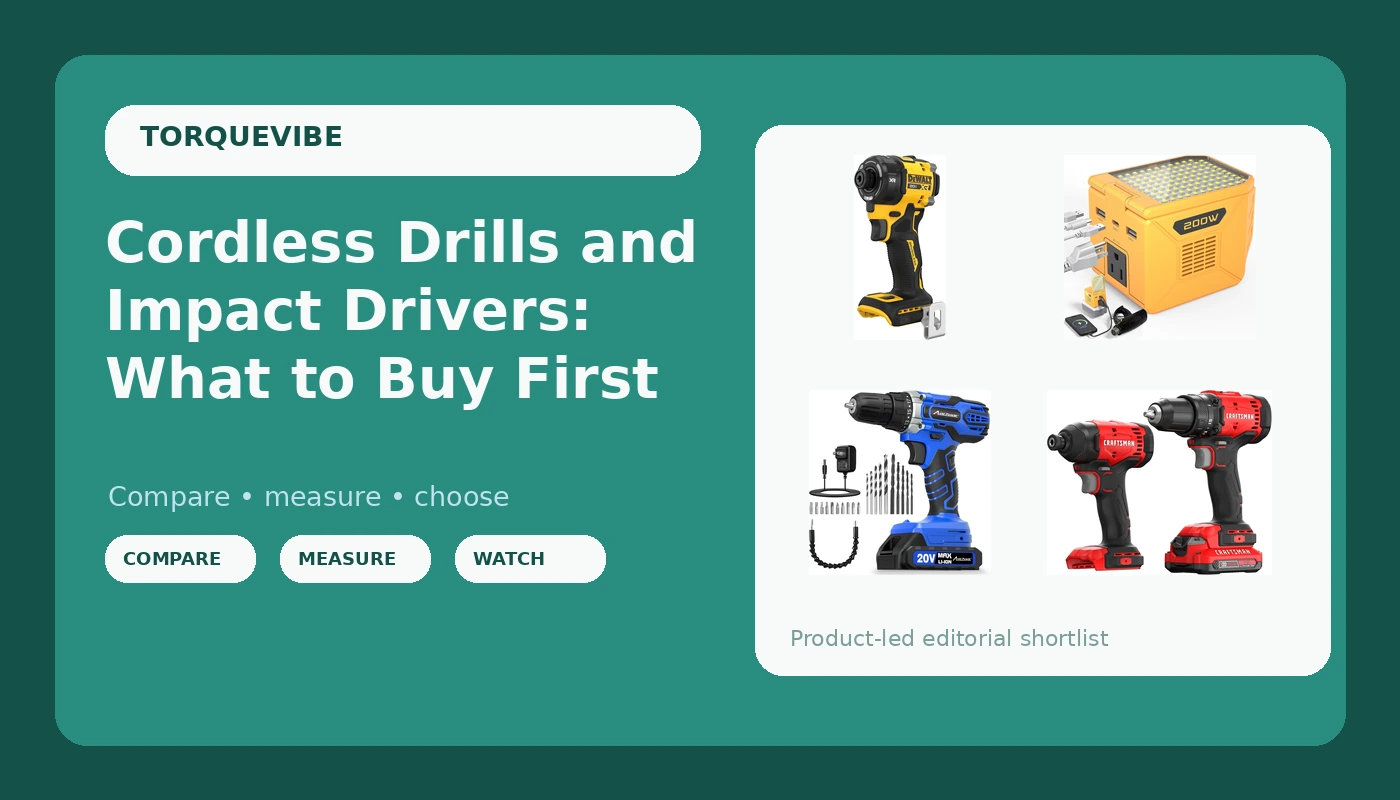
For a first kit, a two-tool combo that pairs a drill with an impact driver on one shared battery is the most practical starting point, because you get both jobs covered with one charger on the bench. If you already own DeWalt 20V MAX batteries, a bare impact driver adds capability without a second charging system. If you only need light household drilling, a low-cost drill kit does the job. And if you already run DeWalt 20V packs, a battery inverter turns them into a small household power source away from an outlet.
Four useful options
| Model | Best fit | What stands out |
|---|---|---|
| CRAFTSMAN V20 Cordless Drill Set and Impact Driver (CMCK201D1) | First two-tool kit | Drill and impact driver plus a 2Ah battery and charger in one box |
| DEWALT 20V MAX 1/4 Inch Hydraulic Impact Driver (DCF870B) | Existing DeWalt 20V owners | Hydraulic impact mechanism, sold as a bare tool |
| Power Inverter for DeWalt 20V Battery 200W (350W Peak) | Off-grid household power | 200W continuous output with 110V AC, USB-A, USB-C, and an LED light |
| AVID POWER 20V Cordless Drill Set | Tight budgets and light DIY | Drill, battery, and charger in a single entry-level kit |
The two-tool starter kit: CRAFTSMAN V20 Cordless Drill Set and Impact Driver
I have been hard on Craftsman, and I will stay hard on it. But there is a version of this purchase where the combo kit makes sense: you need both a drill and an impact driver this weekend, you do not want to buy two chargers, and the work is cabinets, furniture, a fence, a kid's treehouse. This kit covers both roles on one V20 battery. The trade-off is the platform. V20 does not have the same depth of tool selection or the same parts and battery availability as the big two, so treat this as a kit you buy for the tools in the box, not as a ten-year commitment. If you already know you will be adding a miter saw, a recip saw, and a rotary hammer down the road, buy into the platform first and the tools second.
The precision impact driver: DEWALT 20V MAX 1/4 Inch Hydraulic Impact Driver (DCF870B)
If you are already standing in the DeWalt 20V MAX platform, this is the tool that upgrades what your batteries can do. A hydraulic impact driver engages with a pulse instead of the sharp rattle of a conventional impact, which matters on long runs of screws and on anything where noise and control count. It is a bare tool, which is the point: you are not paying for another battery and charger you already have. The honest trade-off is that hydraulic mechanisms are a different animal, and some users find they prefer the raw speed of a standard impact for rough framing. For cabinet work, trim, and driving hundreds of screws at a controlled pace, the smoother engagement is the reason to pick it.
The battery-to-outlet add-on: Power Inverter for DeWalt 20V Battery 200W (350W Peak)
This is not a drill, and it does not pretend to be. It is the accessory that makes a shelf of DeWalt 20V packs useful when there is no outlet in reach: charging a phone, running a laptop, powering a light, keeping a small fan going in a crawlspace. The number that matters is 200 watts continuous. That covers electronics and small loads. It does not cover a circular saw, a shop vac, or anything with a big induction motor, and 350 watts of peak is a startup allowance, not a running rating. Read it as a convenience device for the truck and the job site, not as a generator replacement.
Prices and availability may change. Product images, names, and retailer links must be matched by verified ASIN. Do not state a current price, rating, stock status, or measured result without current evidence.
The budget first drill: AVID POWER 20V Cordless Drill Set
There is a real place for a cheap drill, and it is not on a deck build. It is hanging a curtain rod, assembling flat-pack furniture, driving a few pilot holes for a shelf bracket, and then sitting in a drawer for four months. If that is your list, spending three times as much buys you capability you will never use. Be clear about what you are buying: a light-duty tool with a limited platform behind it. It will not survive a full day of driving three-inch screws into wet lumber, and the battery ecosystem around it is thin. Buy it as a household appliance, use it like one, and it will do exactly what you asked.
The battery platform is the real purchase
Here is the part nobody puts on the box. When you buy a cordless drill, you are not buying a drill. You are buying a battery, a charger, and a promise that the same pack will run a saw, a sander, a light, and a nailer five years from now. That promise is the platform, and the platform is what you actually commit to.
This is why the order of decisions matters. First, look at the batteries already in your garage. If you own DeWalt 20V MAX packs, the sensible move is almost always a bare tool, because the battery and charger are the expensive part of any kit and you already paid for them. Second, look at what you plan to add. A platform with a deep lineup of saws, lights, and outdoor tools is worth more over a decade than a single drill with a slightly higher torque rating.
The mistake is buying a drill because it was on sale, then discovering two years later that the only batteries that fit it are the two that came in the box, and that neither is still sold. Check parts and battery availability before you check the torque number. A tool you can still feed in five years beats a tool that outperformed it once.
Drill or impact driver: match the tool to the fastener
A drill and an impact driver are not interchangeable, and buying both is not upsell. A drill spins a bit with a steady, controllable torque and an adjustable clutch, which is what you want for boring holes and for setting screws in drywall or soft wood without burying them. An impact driver applies rapid rotational hits, which is what you want for long screws, lag bolts, and anything that would stall a drill and twist your wrist.
The short version: drill for holes and control, impact driver for fastening power. If you only own one, own a drill. If you drive a lot of screws, the impact driver is the tool that saves your hands.
- Write down the fasteners you drive most: deck screws, cabinet screws, drywall, machine bolts.
- Decide whether you need to bore holes, which requires a drill and a chuck that accepts round-shank bits.
- Check which battery platforms you already own, and let that narrow the field before you compare anything else.
- Decide between a kit and a bare tool. If you have batteries, a bare tool is usually the better buy.
- Pick one platform and stay on it, then let the tools accumulate around the batteries.
What to check before you buy
- Confirm whether the listing is a kit or a bare tool, since bare tools ship without a battery or charger.
- Check the chuck size on a drill, because a 1/2 inch chuck takes the full range of bits and a smaller one does not.
- Look at whether the driver uses a 1/4 inch hex collet or a chuck, since a collet makes bit changes far faster.
- Read the output rating on any inverter carefully, and treat peak wattage as a startup allowance rather than a running figure.
- Verify that the battery family in the kit is one you are willing to stay on for years, not just for this purchase.
Which option should you choose?
Choose the CRAFTSMAN V20 Cordless Drill Set and Impact Driver when you need a drill and an impact driver at the same time and want both in one box with a battery and charger. Choose the DEWALT 20V MAX 1/4 Inch Hydraulic Impact Driver when you already own 20V MAX batteries and want smoother, quieter fastening from a bare tool. Choose the Power Inverter for DeWalt 20V Battery 200W when you want to turn batteries you already own into household power for small electronics and a work light. Choose the AVID POWER 20V Cordless Drill Set when the work is light household DIY and the budget is the deciding factor.
One caveat applies across all four. These are manufacturer descriptions, not lab results, and kit contents vary by listing. Confirm what is in the box before you order, especially on the bare tools, which require a battery and charger you may or may not already have.
The bottom line
Buy the battery platform first and the tool second, because the batteries outlive everything. If you are starting from nothing and need both hole-drilling and screw-driving, a combo kit is the shortest path to a working setup. If you already own DeWalt 20V MAX packs, a bare hydraulic impact driver and a battery inverter extend what those packs can do without a second charging system. And if your projects are light and occasional, a budget drill kit is honest about what it is. Match the tool to the fastener, match the battery to the decade, and you will not end up with a drawer full of orphaned chargers.