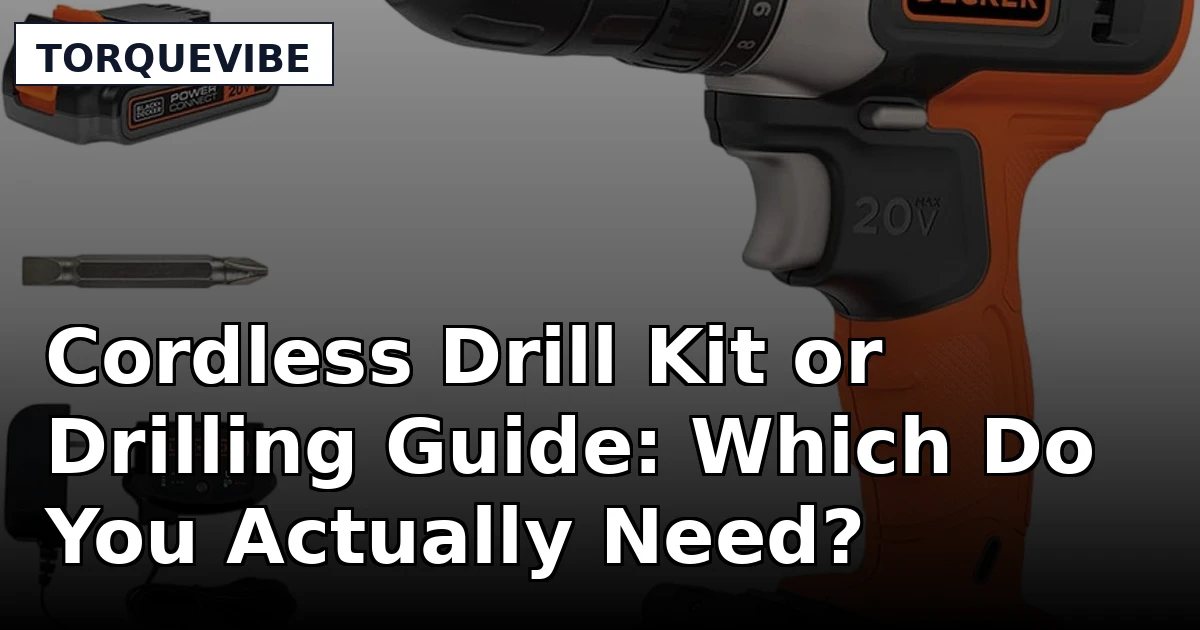
Buying your first cordless drill kit and buying a drilling guide are two different decisions, and mixing them up is how a decent tool ends up sitting in a case for two years. A drill kit is the machine: motor, chuck, clutch, battery, charger, and the battery platform you will keep feeding for years afterward. A drilling guide is a jig that holds the bit square to the work so the hole goes in where you marked it and comes out where you planned. If your list is shelves, flat-pack furniture, a gate hinge, or a deck, the drill is the purchase that unlocks the work. If your list is a workbench, shelf pins, dowel joints, or a run of holes that all have to line up, the guide solves an accuracy problem a drill alone will not solve.
Related: Impact Driver vs Drill: Which One Actually Drives Deck Screws →
Quick answer
A cordless drill kit is the tool that does the work: it spins the bit, holds it in a chuck, and runs on a rechargeable battery you can share across other tools on the same platform. A drilling guide is an accessory that keeps a hand drill square and repeatable for matched holes. Most people should buy the drill kit first and add a guide when a project genuinely calls for straight, identical holes. The three options below are not ranked against one another, because they do different jobs: two are complete drill kits and one is an accuracy accessory.
3 useful options
| Model | Best fit | What stands out |
|---|---|---|
| BLACK+DECKER 20V MAX Cordless Drill Kit with Battery, Charger, Includes Double Sided Drill Bit (BCD702C1) | A first drill for light household work | Ships as a complete kit with battery, charger, and a double sided drill bit |
| CRAFTSMAN V20 Cordless Drill/Driver Kit, 1/2 inch, Battery and Charger Included (CMCD700C1) | Drilling and driving with a larger chuck | A 1/2 inch chuck with battery and charger included in the kit |
| Kreg Portable Drilling Guide, 6 Hardened Drill Guides, KDG-6000 | Straight, repeatable holes with a hand drill | Six hardened drill guides in a portable guide body |
Starter kit: BLACK+DECKER 20V MAX Cordless Drill Kit
This one is aimed at the person who does not own a drill yet. The real value is composition: the drill, the battery, the charger, and a bit all arrive together, so the first hole does not wait on a second order. The trade-off is class. This sits in the entry-level end of cordless kits, and the difference between an entry-level kit and a pro-duty one shows up in the components and the parts pipeline, not in the marketing copy. If your work is hanging shelves, assembling furniture, and driving the occasional screw into a stud, a kit in this class is the sensible starting point. If you are planning a deck build, read the next section before you commit.
1/2 inch drill/driver: CRAFTSMAN V20 Cordless Drill/Driver Kit
Chuck size is the headline here. A 1/2 inch chuck takes the larger shank bits that a 3/8 inch chuck will not grip, which is the difference between owning a drill that covers the small jobs and one that can grow with your projects. The second thing to notice is the word "kit." A bare tool is cheaper up front and more expensive overall if you have no battery to put on it, and this listing includes the battery and charger. What it does not do is tell you which platform you are joining. V20 is a family of tools, so if you already own Craftsman V20 batteries, this is a natural addition. If you own another brand's batteries, you are buying into a second platform, and that is a ten-year decision, not a weekend one.
Accuracy add-on: Kreg Portable Drilling Guide
This is the odd one out, and that is the point. It does not replace a drill and it does not make a drill faster. What it does is address the failure mode that ruins more hand-drilled projects than dull bits ever will: the hole that goes in at an angle. Six hardened drill guides mean six bore sizes held at a fixed angle, so a run of shelf pins or dowel holes lines up instead of wandering. If you already own a drill and your problem is crooked holes rather than a lack of power, this is the cheaper fix by a wide margin. If you do not own a drill, buy the drill first. A guide with nothing to guide is a paperweight.
Prices and availability may change. Product images, names, and retailer links must be matched by verified ASIN. Do not state a current price, rating, stock status, or measured result without current evidence.
What a cordless drill kit actually includes
The word "kit" is doing more work in these listings than the voltage number, so it pays to know what you are comparing. A kit generally bundles the drill body with a battery and a charger. A bare tool is just the body, which only makes sense if you already own compatible batteries and a charger. That single distinction explains most of the price gap between two drills that look nearly identical in a photo.
The battery is the part that outlives the drill. Every cordless tool you buy afterward either shares that battery or forces you to own a second system with its own charger and its own spare packs. That is why the platform question matters more than the drill question. When you buy the first tool, you are choosing a family, and the tools you add over the next several years will all hang off that choice.
Finally, the accessories in the box tell you who the kit is for. A kit that includes a bit is aimed at someone who owns no bits yet. A kit that includes only the tool, battery, and charger assumes you already have a bit set and a driver set on the bench. Neither approach is wrong. They just describe different buyers.
Chuck, clutch, and the numbers that matter
Three features decide whether a drill fits your work, and none of them is the voltage printed on the side.
The chuck is the three-jaw grip that holds the bit. Size matters: a 1/2 inch chuck accepts larger shanks than a 3/8 inch chuck, so it covers more of the bits you are likely to buy later. A chuck that cannot hold a bit tight is a drill that lies to you about everything else.
The clutch is the adjustable collar that slips at a set torque so the drill stops driving before the screw buries itself in drywall or splits a softwood face. Learn to set it and you will stop stripping screw heads this weekend.
The battery platform is the long game. Voltage is a family name more than a power rating, and the number tells you which batteries fit, not how hard the tool pulls.
And then there is the bit and the angle. A sharp bit at a true 90 degrees beats a mediocre bit at a sloppy angle every time. That is the entire case for a drilling guide: it takes the angle out of your hands.
- Write down the last five things you drilled or drove.
- Decide whether your problem was power or accuracy.
- Check which batteries and chargers you already own.
- Match chuck size to the largest bit shank you expect to use.
- Buy the drill first, then add a guide when matched holes matter.
Practical guidance before you click buy
- Count your existing batteries first. A second platform costs more over five years than the drill costs today.
- Treat the chuck as the spec that ages worst. Larger is more versatile, but only if the jaws hold.
- If your holes are crooked and not underpowered, a guide is the cheaper fix.
- If you have no drill at all, skip the guide. It cannot do anything on its own.
- Buy the bit set with the drill, not three weeks later. A kit with one bit is a starting point, not a workshop.
Which option should you choose?
Choose the BLACK+DECKER 20V MAX Cordless Drill Kit when you are buying your first cordless drill and want the battery, the charger, and a bit to arrive in one box. Choose the CRAFTSMAN V20 Cordless Drill/Driver Kit when a 1/2 inch chuck and an included battery and charger matter more to you than starting in the smallest kit class. Choose the Kreg Portable Drilling Guide when you already own a working drill and your real problem is holes that wander instead of holes that stall.
One caveat worth stating plainly: these three products are not interchangeable, so no single one of them is the right answer for everybody. Nothing here is a claim about measured runtime, torque, or durability, and no rating or stock status is being repeated. Verify the current specifications, included contents, and compatibility on each listing before you buy, because kits get revised and bundled contents change.
The bottom line
A cordless drill kit is the purchase that lets you do the work, and a drilling guide is the purchase that makes the work accurate. For most people starting from nothing, the drill kit comes first, and the choice between an entry-level kit and a kit built around a 1/2 inch chuck comes down to how much of your future work involves larger bits and heavier driving. The guide enters the picture later, when a project demands a run of straight, identical holes and a hand drill alone keeps missing. Pick the drill for the platform you are willing to live with, add the guide when the job asks for it, and neither purchase will be wasted.