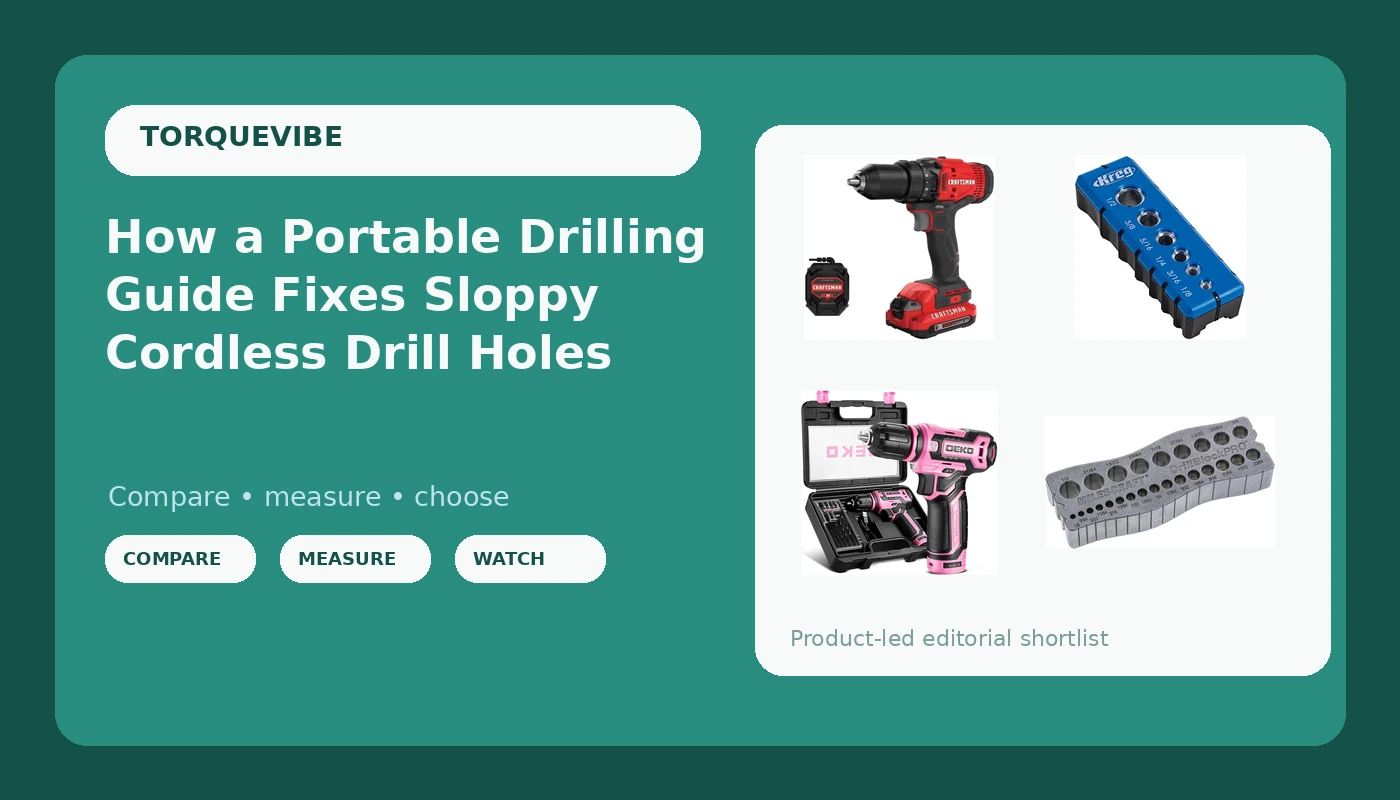
You can spend whatever you want on a cordless drill and still bore a crooked hole. A drill is a motor, a chuck, and a trigger. It has no opinion about whether the bit is square to the work, so the bit goes wherever the first half second of contact sends it. That is how shelf brackets end up 3/8 inch off the mark, how cabinet hinges sit proud of the face frame, and how anchors land in hollow drywall. A portable drilling guide is the low-tech answer: a block or plate that holds the bit perpendicular while the drill does the spinning. This is an explainer on how those two jobs divide up, and on four specific options, two cordless drills and two drilling guides, along with the honest limits of each.
Related: Cordless Drill Battery Platforms: The Ten-Year Commitment →
Quick answer
If your problem is power, meaning you need to bore holes and drive screws with one tool running off one battery, a cordless drill/driver kit is the starting point. If your problem is accuracy, meaning the holes need to be square to a face, an edge, or a round piece of stock, the drill is only half the equation and a guide does the rest. Among these four options, the CRAFTSMAN V20 kit is a conventional cordless drill/driver with the battery and charger in the box, the DEKOPRO 12V set is a light-duty drill kit that arrives with accessories, the Kreg KDG-6000 is a portable drilling guide with six hardened guides, and the Milescraft 1307 Drill Block PRO is an all-metal guide block covering 25 hole sizes. The right pick depends on whether you are short on torque or short on square.
Four useful options
| Model | Best fit | What stands out |
|---|---|---|
| CRAFTSMAN V20 Cordless Drill/Driver Kit, 1/2 inch (CMCD700C1) | General drilling and driving on one battery platform | 1/2 inch chuck; battery and charger included |
| DEKOPRO 12V Power Drill Set | Light household tasks and a gift-ready starter kit | 12V drill rated at 800 RPM; tool set and gift box included |
| Kreg Portable Drilling Guide (KDG-6000) | Field work where the bit has to stay square off the bench | Six hardened drill guides in a portable body |
| Milescraft 1307 Drill Block PRO | Repeated holes in many diameters at the bench or in hand | All-metal block with 25 guide sizes, 1/8 inch to 1/2 inch in 1/64 inch increments |
The everyday cordless drill: CRAFTSMAN V20 Cordless Drill/Driver Kit, 1/2 inch
Here is the part the box will not tell you. A drill/driver kit is a battery platform purchase dressed up as a tool purchase. The drill is the first thing you hang on that battery, and in five years you will still be buying batteries for it, so the question worth asking is not how this tool feels on day one. It is whether the platform still sells what you need when the original pack gives up. Value-oriented lines like this one trade some long-term parts and battery availability for a lower entry cost, and that trade is worth naming out loud before you commit. For a homeowner drilling a few dozen holes a year, that trade is usually fine. For someone boring 200 holes a weekend, it is the whole decision.
The light-duty starter kit: DEKOPRO 12V Power Drill Set
Set expectations correctly and a 12V kit like this earns its shelf space. The job it does well is the small job: pilot holes in pine, cabinet hardware, furniture kits, curtain rods. The job it does badly is anything that asks for sustained torque, like a 1/2 inch spade bit through wet lumber or a long run of deck screws. If you already know you are heading toward decks and framing, this is a starter, not a finish. If you are buying for a first apartment or a gift, the complete box is the appeal, and the accessories save a second trip to the store.
The portable guide for field work: Kreg Portable Drilling Guide (KDG-6000)
A guide like this solves a specific, common failure. You have the work in place, the drill in one hand, and no way to clamp anything. The bit touches down, walks a sixteenth of an inch, and now the hole is where the drill wanted it rather than where you marked it. Hardened guide bushings take that decision away from the bit. The trade-off is that a guide only covers the bit diameters its bushings accept, and it only helps if you can hold it flat against the surface while you drill, which is why a small clamp lives in the same bag.
The multi-size drill block: Milescraft 1307 Drill Block PRO
The V-groove is the detail worth understanding, because it is what separates a drill block from a flat plate with holes in it. Round stock, meaning dowels, pipe, and closet rod, will roll under a flat guide and send the bit off center. A groove gives the round surface two points of contact and holds it still. The 1/64 inch increments matter for the same reason: if the bushing is loose around the bit, the bit wanders inside the guide and you have bought nothing. A drill block is also the tool that makes a cheap drill behave, because a straight hole is a function of the bit's direction, not the motor's torque rating.
Prices and availability may change. Product images, names, and retailer links must be matched by verified ASIN. Do not state a current price, rating, stock status, or measured result without current evidence.
Why a drill and a guide are two different jobs
The number on the side of a drill box is torque, measured in inch-pounds, and it tells you how hard the tool can twist. It says nothing about whether the bit enters the wood at 90 degrees. Those are separate problems with separate solutions, and confusing them is why people buy a bigger drill and still get crooked holes.
Three things push a bit off course. First, the surface itself: wood grain, a knot, or a slightly crowned board will steer a bit that has nothing guiding it. Second, the start: a bit touching a smooth surface has almost no purchase, so it skates until a flute catches. Third, the operator: a hand holding a drill is a hinge, not a jig, and it will tilt as the hole deepens. A drilling guide addresses all three at once by fixing the bit's angle before the flutes ever bite.
That is also why a drill press and a handheld guide are cousins rather than competitors. The press holds the bit square and moves it down a fixed axis. A guide does the same job in a package small enough to carry, at the cost of depth control. Neither one adds torque. If your problem is a bit stalling in a deep hole, no guide will fix it; you need more tool or a smaller bit.
The practical takeaway is that these two purchases should be evaluated on different scales. Buy the drill for the battery platform, the duty cycle, and the chuck. Buy the guide for the bushing sizes and the shape of the surface you are drilling into.
How to match the drill, the bit, and the guide
- Define the hole before the tool. Write down the diameter, the depth, and the material. A 1/4 inch hole in pine for a shelf pin and a 1/2 inch hole through a wet 2x10 are different purchases, and the material decides how much the bit will wander.
- Pick the bit, then check what holds it. A guide is only useful if its bushing matches your bit shank and diameter, so confirm the sizes on the listing before buying. The Milescraft block covers 1/8 inch to 1/2 inch in 1/64 inch increments, which is a wide net; the Kreg guide lists six hardened guides, so check that your common sizes are among them.
- Match the guide to where the hole lives. Bench work with many diameters points to a drill block. Work up a ladder, inside a cabinet, or on an installed railing points to a portable handheld guide. Round stock and corners specifically call for a V-groove design.
- Match the drill to the duty cycle. A 12V kit rated at 800 RPM suits light household tasks. A 1/2 inch chuck drill/driver with a battery and charger in the box is the more general-purpose shape of tool. Do not buy torque you will never ask for, and do not buy a light kit for heavy work.
- Test on scrap of the same material. Every combination of bit, guide, and wood behaves a little differently. One hole in an offcut tells you more than any spec table, and it costs you thirty seconds.
Habits that keep holes square on a real job
- Mark the hole with an awl or a nail set instead of a pencil. A small dimple gives the bit a place to sit so it stops skating across the surface.
- Start slow and let the bit establish itself before you squeeze the trigger all the way. Speed at the start is what turns a mark into a scar.
- Clear the flutes. A packed bit has nowhere to put the chips, so it heats up, dulls, and starts hunting sideways in the hole.
- Clamp the work whenever you can. A guide holds the bit square; a clamp holds the board still. Together they remove most of the human error.
- Watch the bit, not the drill body. The flutes tell you whether you are square. The housing hides it.
Which option should you choose?
Choose the CRAFTSMAN V20 Cordless Drill/Driver Kit, 1/2 inch when you want a general-purpose cordless drill/driver with a 1/2 inch chuck and a battery and charger included, and you are prepared to think about the platform you are joining. Choose the DEKOPRO 12V Power Drill Set when the work is light household drilling and driving, and you want a complete kit in a gift box rather than a bare tool. Choose the Kreg Portable Drilling Guide (KDG-6000) when the holes have to be drilled in place, away from a bench, and you need six hardened guides to keep the bit square. Choose the Milescraft 1307 Drill Block PRO when you want one all-metal block covering 25 sizes from 1/8 inch to 1/2 inch, especially for round stock and corners.
A caveat worth repeating: the drills and the guides here are not substitutes for one another. Buying a guide does not replace a drill, and buying a drill does not make holes straight. If you are starting from nothing, the drill comes first and the guide is the next twenty-five dollars that improves every hole you drill after it. Check the current listings for the exact bushing sizes, chuck size, and what is included in each kit, because those details decide whether a tool fits your work.
The bottom line
Straight holes are a two-part problem, and only one part is the drill. A cordless drill supplies rotation; a drilling guide supplies direction. Buy the drill for the battery platform and the duty cycle you actually have, and buy the guide for the bushing sizes and the shape of the surface you are drilling into. If you are drilling in place and cannot clamp the work, a portable guide earns its place in the bag. If you are at a bench with many bit sizes, an all-metal drill block covering 1/8 inch to 1/2 inch in 1/64 inch increments does more for your accuracy than a more expensive drill ever will.