Related: Cordless Drill vs Impact Driver: Which One Do You Actually Need?
Twenty-two years of running a crew out of Cleveland taught me that most people don't have a power tool problem. They have a control problem. The drill is fine. The bit wanders, the screw strips, and the hole comes out at an angle because a half-inch spade bit in wet lumber goes wherever it feels like going. A drill guide for straight holes fixes most of that for less than the cost of a spare battery, and it is the cheapest upgrade in this entire article.
But a guide only steadies the bit. It doesn't spin it. So this covers both halves of the equation: two cordless kits that belong in different hands for different reasons, and two drilling guides that solve a problem no drill can solve by itself. I've burned out more drills than most people will ever own, and everything below comes from the same rule I use on the truck. The tool has to survive the job, not the spec sheet.
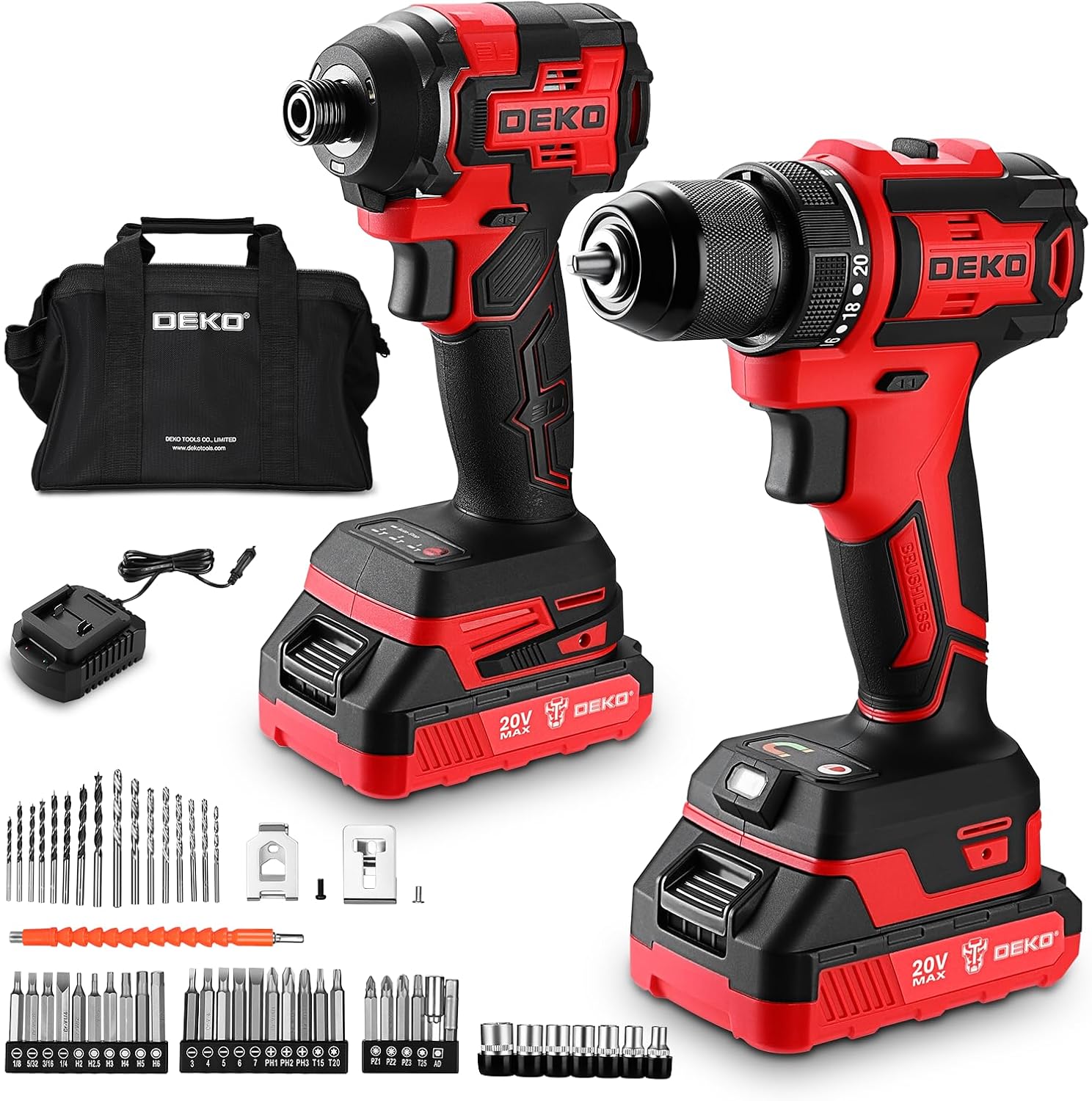
The set I'd start with: DEKOPRO 20V Brushless Drill and Impact Driver
Two tools, one battery platform, both brushless, two 2.0Ah batteries, a charger, a bag, and a pile of accessories. The headline here isn't the drill. It's the impact driver sitting next to it in the case, because the impact driver is the tool that actually drives a 3-inch deck screw without camming out, stripping the head, or cooking a brushed motor on a Friday afternoon.
Brushless matters more than any number printed on the box. No carbon brushes means nothing inside the motor to wear down, more runtime per charge, and a tool that doesn't get hot enough to smell. If you're buying one kit and you want it still working in five years, that is the line that matters.
Honest caveats. The 2.0Ah batteries are small, and on a long day of framing you'll be swapping them more often than you'd like. The accessory bundle is mostly filler, and you'll be replacing the driver bits with decent ones inside a month. The bag is a bag.
What you're actually paying for is the combination: a drill for boring and a driver for fastening, on a platform you can keep adding tools to. The quick-release collet on the driver means bit changes in a second with no chuck to tighten. That is the difference between driving 200 screws and hating every one of them.
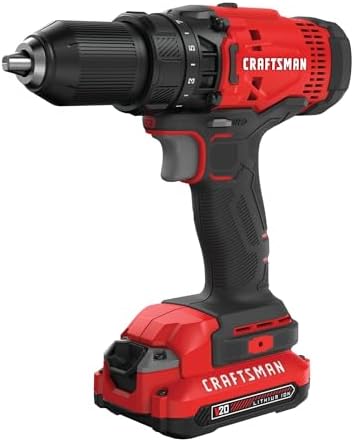
The budget kit: CRAFTSMAN V20 Cordless Drill/Driver Kit
This is the kit that shows up in every big-box aisle at a price that looks like a mistake. It's a drill/driver, one battery, a charger, and a half-inch chuck. For flat-pack furniture, shelf brackets, pilot holes for hinges, and hanging a picture frame, it does the job without a fuss, and the clutch collar lets you dial the torque down so you stop burying screws through drywall.
Where it falls apart is when you ask it to be something it isn't. There is no impact driver in this box, so the day you decide to build a deck or run a fence, you're back at the store buying the tool you should have bought first. The price looks like a bargain right up until you do that math twice.
Craftsman has spent a decade trading on the name. The V20 kit looks like DeWalt's little brother, and on light duty it acts like one. I've watched too many of these come out of a homeowner's garage with a smoked motor and a chuck that won't bite a bit anymore. If you're already on the V20 platform and you need a second drill for the garage shelf, fine. If you're starting from zero and you plan to do real work, put the money toward the set above.
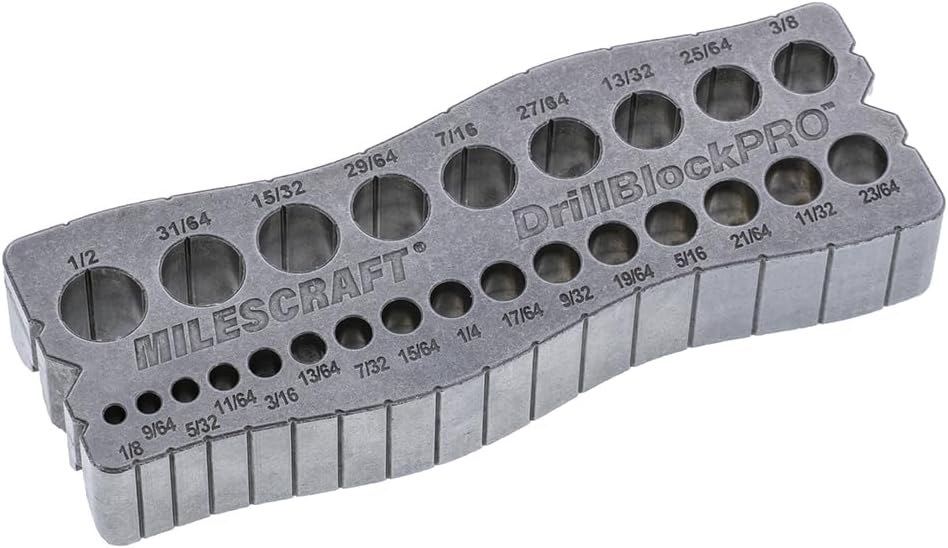
Best for straight holes in round stock: Milescraft 1307 Drill Block PRO
Twenty-five drill guides in one all-metal block, sized from 1/8 inch to 1/2 inch in 1/64 inch increments, with a dual V-groove that cradles round stock and seats into corners. If you've ever tried to drill a centered hole through a dowel with a hand drill and a prayer, this is the tool that ends that argument.
The V-groove is the part people overlook. Round stock rolls, and a bit that catches a curved surface walks off the mark before it ever bites. Set the dowel or the pipe into the groove, clamp the work, pick the guide that matches your bit, and the block holds everything square while you drill. The same block handles pilot holes in hinge plates and corner work where a drill won't sit flat on its own.
It's handheld, so it's only as good as your setup. Clamp the workpiece, and clamp the block if you can. Start the drill slow, let the guide take over, and don't lean on it. A guide keeps you square. It does not make a dull bit sharp.
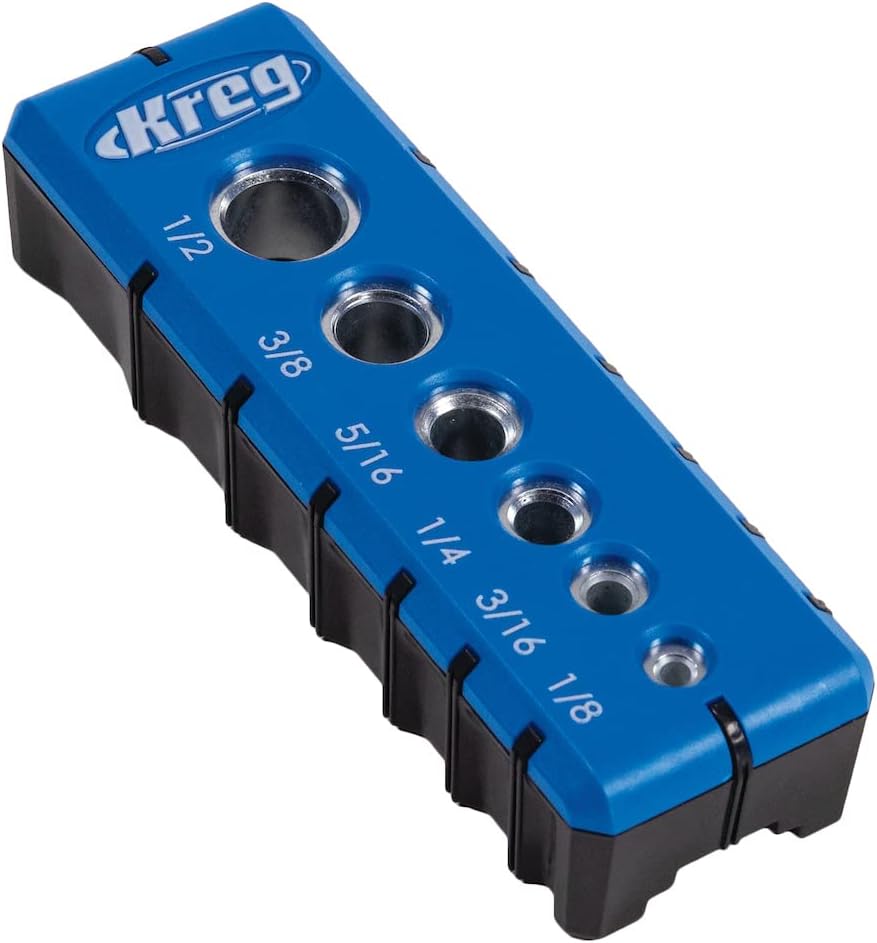
Best for repeatable holes along an edge: Kreg Portable Drilling Guide
Six hardened drill guides in a portable body that clamps to the work. Where the Milescraft block wins on sizes and round stock, this one wins on repetition. When you need a run of holes down a rail, a stile, or a fence board at the same setback every single time, you clamp it once and drill the whole run without re-marking anything.
That consistency is the entire point. Hand-marking eight holes down a board and hitting the same line eight times is a skill most people don't have and don't need to develop. Clamp the guide, drill, move it, repeat. Hardened guides also don't wallow out the way a drilled hole in a scrap block does, which is what everybody uses right up until they get tired of making a new block every month.
If you're drilling into an edge or a face and the spacing has to match hardware, this is the one I'd reach for. If you're drilling one centered hole through a piece of round stock, the Milescraft block is the better call.
What I check before a tool earns a spot in the truck
The chuck is the first thing I touch, because a chuck that slips is a tool that lies. I don't care how many inch-pounds the box claims if the jaws won't hold a new bit under load.
Then the motor. Brushless or brushed is not marketing language, it's the difference between a tool that lasts a season and a tool that lasts a decade. After that: can I still buy batteries and parts for this platform in five years, how much does it weigh in my hand at the end of a day, and would it survive being dropped off a ladder once. Jobsites are not labs. Everything gets dropped eventually.
Guides get judged the same way. Does the block hold the bit square under load, does it clamp to real material instead of only to a clean bench, and does it survive the drop. A guide that lives in a drawer because it's fussy is a guide that isn't working.
Where the money actually goes
The battery platform is the real purchase. The drill is just the first tool you hang on it, and ten years from now you're still married to that platform. That's why the DEKOPRO set makes sense as a starting point: two tools, one charger, and a family you can grow. It's also why a cheap drill with a dead-end battery is the most expensive tool in the garage.
The drill versus impact driver split trips up more people than anything else. A drill bores holes and drives screws with finesse. An impact driver drives screws with force and does it all day without complaint. If your project has more than a dozen long screws in it, you want the driver. If it has holes in it, you want the drill. Most real projects have both, which is why the kit with both tools in it is the smarter buy.
And the guides are the cheapest skill you can buy. Nobody's hands hold a half-inch bit perfectly square, no matter how long they've been at it. Twenty-five dollars of metal does what twenty-two years of practice still can't guarantee on a curved surface.
Drill, driver, or guide: the reference table
This is the table I keep in my head when I'm loading the truck. Match the job to the tool before you start, because the wrong tool is how bits get burned and screws get stripped.
| Job | Reach for | Setup | Notes |
|---|---|---|---|
 Visit on Amazon → Visit on Amazon →Deck screws, 3 inch, all day |
DEKOPRO impact driver | Quick-release collet, no chuck | A drill will cam out and strip heads |
| Boring 1/2 inch holes through framing | DEKOPRO drill | Low gear, sharp spade bit | Let the bit cut, don't lean on it |
 Visit on Amazon → Visit on Amazon →Centered holes in dowels, pipe, round stock |
Milescraft Drill Block PRO | Dual V-groove, clamp the work | Pick the guide that matches the bit |
| Pilot holes for hinges and hardware | Milescraft Drill Block PRO | Guide sized to the screw | Square beats fast |
 Visit on Amazon → Visit on Amazon →A run of holes down a rail or stile |
Kreg Portable Drilling Guide | Clamp, drill, move, repeat | Consistency is the point |
| Holes along an edge at a fixed setback | Kreg Portable Drilling Guide | Set the setback once | Same distance every time |
 Visit on Amazon → Visit on Amazon →Flat-pack furniture and shelf brackets |
CRAFTSMAN V20 kit | Set the clutch | Set the clutch and stop stripping screws |
| Hanging a picture, small pilot holes | CRAFTSMAN V20 kit | Smallest bit you own | Light duty is what it's built for |
The pattern in that table is simple. Long fasteners want an impact driver. Holes want a drill. Anything round, angled, or repeated wants a guide under it.
Should you buy the DEKOPRO 20V Brushless set?
Yes, if you want both tools on one platform without paying pro money. The brushless drill and brushless impact driver are the real purchase here, and the impact driver alone justifies the kit for anyone driving deck screws or building anything bigger than a birdhouse.
The compromises are real but they're the right compromises at this price. Two small batteries instead of one big one means you always have a charged pack waiting, even if you're swapping more often. The accessory bits are filler, so buy good driver bits and toss the rest. What you keep is a matched pair of tools that share one charger and one battery, which is the way every serious kit is built.
If I were handing a first kit to my own apprentice on a Monday morning, this is the one I'd hand over.
Should you buy the CRAFTSMAN V20 kit?
For light duty around the house, it's fine, and I'll say that out loud. Assembling furniture, hanging shelves, drilling pilot holes in drywall and soft pine, it does all of that. Set the clutch, let the tool do the work, and you'll stop stripping screws this weekend.
But understand what you're buying. It's half a kit. There's no impact driver, one battery, and a motor that won't forgive a hard season. If your projects are going to grow, buy the set with both tools and skip the second trip to the store.
And whichever drill you end up with, add a guide to the order. Straight holes are a tool problem, not a talent problem, and that's the cheapest lesson in this whole article.