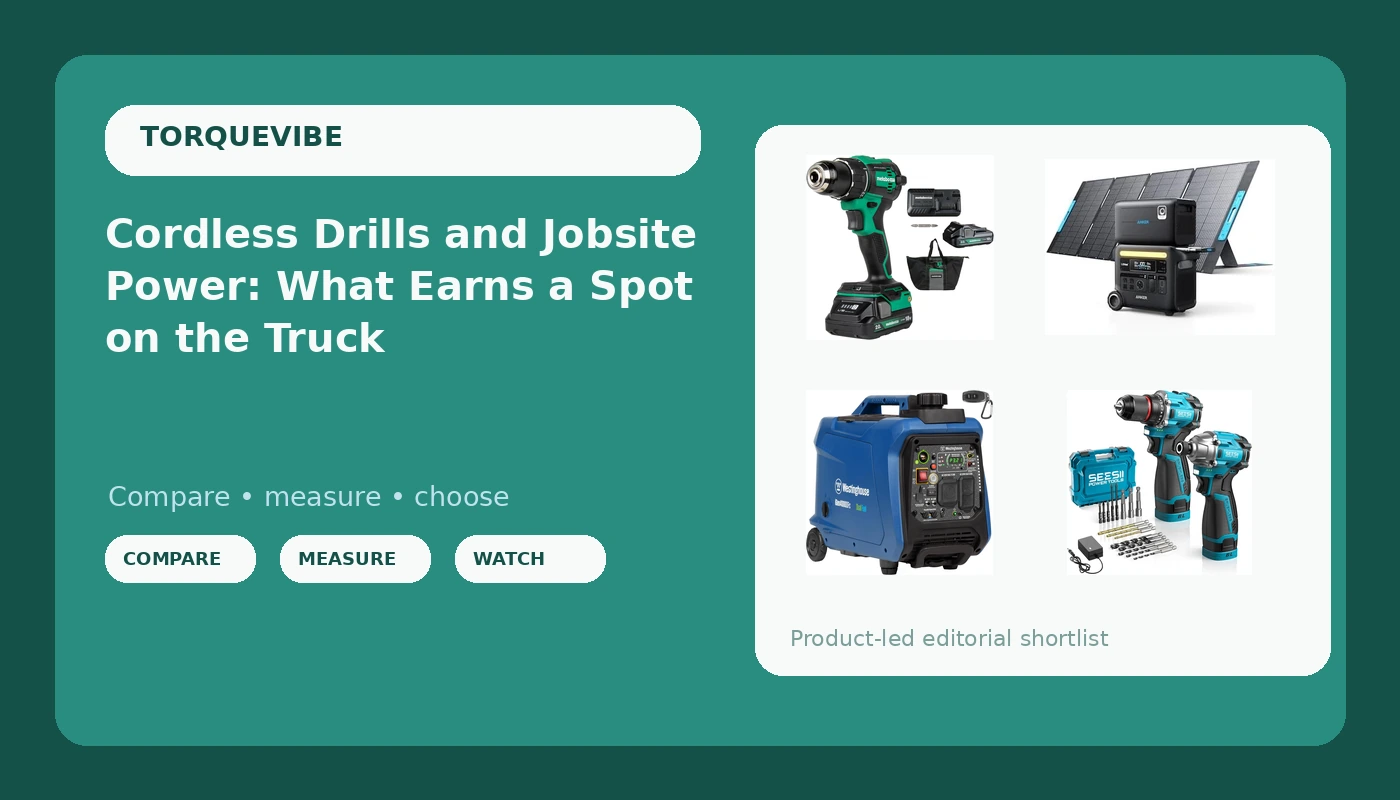
A cordless drill and jobsite power plan only works when the two halves match each other. The drill has to drive the fasteners you actually use, and the power source has to keep that drill running when the nearest outlet is a hundred feet away behind a locked door. Most people buy the tool first and treat power as an afterthought, then wonder why a good drill feels weak on a job where an old corded model never blinked. The four products below cover different halves of that problem: a brushless drill kit built around a battery platform, a drill and impact driver combo aimed at home work, a dual fuel inverter generator for jobs with no power at all, and a large LiFePO4 power station with a solar panel for quiet, fume-free output. Here is what each one is for, and where each one stops.
Related: How to Read Drill Torque Specs Without Getting Fooled →
Quick answer
If you drill holes and drive screws around the house, a brushless drill and impact driver combo kit covers it. If you are buying into a battery platform you intend to keep for a decade, a single-brand brushless drill kit on a shared battery line is the better long-term purchase. If your work happens where there is no grid power, a dual fuel inverter generator covers long runtime on gas or propane, while a large LiFePO4 portable power station with solar charging covers quiet, fume-free power for tools and electronics. These four do not replace each other. They answer different questions.
4 useful options
| Model | Best fit | What stands out |
|---|---|---|
| Metabo HPT 18V MultiVolt Cordless Brushless Driver Drill Kit, DS18DEX | Buyers committing to one battery platform | Brushless motor in an 18V MultiVolt kit |
| Cordless Drill Impact Driver Brushless Power Tool Combo Kits for Home DIY | Homeowners and DIY work | Two brushless cordless tools in one kit |
| Westinghouse 4000 Peak Watt Super Quiet Dual Fuel Portable Inverter Generator, Remote Electric Start, Gas & Propane Powered, RV Ready, CO Sensor, Parallel Capable | Jobs with no outlet nearby | Dual fuel, remote electric start, CO sensor, parallel capable |
| Anker SOLIX F2600 Portable Power Station, PowerHouse 767 and 760 Expansion Battery, with 1×400W Solar Panels, 5120Wh LiFePO4 Battery with 4 AC Outlets Up to 2400W for Home, Outdoor Camping, RV | Quiet power for tools and devices | 5120Wh LiFePO4 capacity, four AC outlets listed up to 2400W, 400W solar panel included |
The platform drill: Metabo HPT 18V MultiVolt Cordless Brushless Driver Drill Kit, DS18DEX
This is the drill you buy when you are thinking past the first tool. A kit that arrives with its own battery and charger costs more up front than a bare tool, but it puts you inside a platform, and the platform is the part you live with. When the drill is five years old and the batteries are not, you want to be able to buy replacements without changing brands. Brushless matters here for the same reason: no carbon brushes to wear down, which is usually the difference between a tool that lasts a season of hard use and one that lasts a decade. The trade-off is commitment. Buy into one battery line and the second tool, the third tool, and every pack after that gets cheaper and simpler, but only if you stay put. If you already own packs from a different platform, this kit is a duplicate investment, not an upgrade.
The starter combo: Cordless Drill Impact Driver Brushless Power Tool Combo Kits for Home DIY
The drill and the impact driver are not the same tool, and this kit is the cheapest honest way to end up with both. A drill with a clutch is what you want for holes, for driving screws into softwood at a controlled depth, and for anything where burying the head is a failure. An impact driver is what you want for long deck screws and lag bolts, because it converts rotating impact into driving force instead of asking your wrist to supply it. People who own only a drill try to make it do both jobs, then wonder why their arm is done after forty screws. The trade-off with a DIY-oriented combo is the same as with any kit sold as a set: you are getting two tools at a combined price, and the specs sit in the middle rather than at the top of the range. For a homeowner building a fence or hanging cabinets, that is the right trade. For a crew driving thousands of fasteners a week, it is not.
The fuel option: Westinghouse 4000 Peak Watt Super Quiet Dual Fuel Portable Inverter Generator, Remote Electric Start, Gas & Propane Powered, RV Ready, CO Sensor, Parallel Capable
Read the wattage carefully, because this is where buyers get burned. The 4000 figure is peak watts, which is the short surge a generator can absorb when a motor starts. Running watts, the number that matters for an all-day load, is always lower. An inverter generator is the right type for tools and electronics because the inverter stage produces cleaner, more stable power than a conventional open-frame unit, and it is why inverter models are the ones you see on job sites where someone is also charging batteries and laptops. Dual fuel is the feature that separates this from a single-fuel unit: gasoline gives you more output, propane gives you fuel that stores indefinitely and does not gum up a carburetor during the off-season. The CO sensor is a safety feature, not a convenience, and it should be treated that way. The trade-offs are weight, noise, and maintenance. A generator needs oil changes, fuel stabilizer, and an exercise schedule. If your power problem is a phone and a few batteries, this is more machine than the job requires.
The battery bank: Anker SOLIX F2600 Portable Power Station, PowerHouse 767 and 760 Expansion Battery, with 1×400W Solar Panels, 5120Wh LiFePO4 Battery with 4 AC Outlets Up to 2400W for Home, Outdoor Camping, RV
This is the quiet half of the power question. A battery station produces nothing to smell, nothing to pour, and nothing to start with a pull cord, which makes it usable indoors, in a garage with the door down, or inside an RV where a generator would be a bad idea. LiFePO4 chemistry is the reason these units have gotten serious: it handles deep cycling better than older lithium formulas and holds up to being charged and drained repeatedly. The solar panel in the box means you can refill it without a wall outlet, though solar charging is slow compared to plugging into a wall, so plan around that rather than expecting a fast turnaround. The real trade-off is capacity against draw. A 2400W outlet rating sounds like it runs anything, but large motor loads pull hard, and every hour of heavy draw eats a fixed amount of stored energy. This is a power source for tools that run in bursts, not for a table saw running all afternoon. Know your load before you assume the capacity is enough.
Prices and availability may change. Product images, names, and retailer links are matched to verified listings. No current price, rating, stock status, or measured result is stated here without current evidence.
What the numbers on the box actually tell you
Voltage is the least useful number on the label. An 18V drill and a 20V drill are close cousins, and the difference between them says more about marketing departments than about torque. What matters is the motor design and how the tool delivers power under load. A brushless motor removes the carbon brushes that wear out on a brushed tool, which means less friction, more runtime per charge, and a longer service life. That is a real difference you can measure in years, not a slogan.
Torque ratings deserve suspicion. The inch-pound figure on the box is usually a peak stall number taken with a fresh battery, which is not the torque you get at screw 200 with a warm motor and a tired arm. Treat it as a ceiling, not a working number.
Then look at the parts that actually fail. The chuck is the number one failure point on cheap drills, and a chuck that slips under load is a tool that lies to you. On an impact driver, the equivalent is the collet, the quarter-inch hex holder that bits click into. A collet that wears loose starts dropping bits, and there is no tightening your way out of it. Check the clutch collar on a drill too: that is the ring that stops the chuck from spinning at a set torque, and without a working clutch you will bury screws through drywall and split every board you touch.
Finally, check the battery line. Can you buy packs and chargers for it in five years? Is the platform big enough that the drill is only the first tool? That question outlives every spec on the box.
Matching the power source to the work
Start with how long the tool needs to run and whether you can plug in. A cordless drill runs for minutes at a time, so battery capacity is rarely the limit. A generator or a power station has to cover hours, and that changes the math completely.
Inverter generators produce cleaner power than conventional open-frame units, which is why they are the type to consider when electronics and battery chargers are part of the load. Dual fuel adds a second option: gasoline for maximum output, propane for fuel that stores without going bad. The CO sensor on a generator is a safety device, and it is not a substitute for running the unit outside, away from windows and doors.
Portable power stations trade fuel for silence. There is nothing to maintain, nothing to spill, and nothing to start, but the stored energy is finite and the recharge rate depends on how you refill it. A 400W solar panel is a genuine off-grid option, just a slow one.
For a home shop, the honest answer is often both: a battery station for indoor and short-run work, and a fuel generator for long outages and heavy loads.
- List the tools you need to run and how many minutes or hours each one runs.
- Add up the running watts, not the peak watts, and check that total against the source.
- Decide whether the work happens indoors or outdoors, since fumes rule out fuel engines inside.
- Check the recharge path: wall outlet, solar panel, gasoline, propane, or some combination.
- Confirm parts and batteries will still be available in five years before you commit to a platform.
Practical guidance
- Match the tool to the fastener. A drill with a clutch drives screws; an impact driver drives long fasteners and lag bolts.
- Buy into one battery platform and stay there. Mixing brands means duplicating chargers and packs forever.
- Set the clutch low and raise it only until the screw seats. Let the tool stop itself instead of your wrist.
- Store propane for the off-season and treat gasoline with stabilizer, or run the generator dry before it sits.
- Size a power station by watt-hours of real load, not by the biggest number on the listing.
Which option should you choose?
Choose the Metabo HPT 18V MultiVolt Cordless Brushless Driver Drill Kit, DS18DEX when you want one brushless drill on a battery platform you plan to build on for years. Choose the Cordless Drill Impact Driver Brushless Power Tool Combo Kits for Home DIY when you are a homeowner who needs both a drill and an impact driver without buying them separately. Choose the Westinghouse 4000 Peak Watt Super Quiet Dual Fuel Portable Inverter Generator, Remote Electric Start, Gas & Propane Powered, RV Ready, CO Sensor, Parallel Capable when the work is far from an outlet and you need hours of runtime on gas or propane. Choose the Anker SOLIX F2600 Portable Power Station, PowerHouse 767 and 760 Expansion Battery, with 1×400W Solar Panels, 5120Wh LiFePO4 Battery with 4 AC Outlets Up to 2400W for Home, Outdoor Camping, RV when you need silent, fume-free power indoors or in an RV and can recharge from a wall or a solar panel.
One caveat that applies to all four: none of these listings gives you the number that matters most, which is how the tool behaves after a long run under load. Runtime, torque under heat, chuck grip after hundreds of bit changes, and battery health after a year of cycles are the things that separate tools, and those are not on a spec sheet. Buy from listings with a clear return window, test the tool hard in the first weeks, and let that tell you more than any watt or volt figure.
The bottom line
These four products are not competitors. A brushless drill kit gets you onto a battery platform, a drill and impact driver combo covers household work with both tools, an inverter generator delivers long runtime where there is no grid, and a LiFePO4 power station delivers quiet capacity with a solar recharge path. Decide first whether your bottleneck is the tool or the power, then pick the one that solves that half. Buying both a drill and a power source from the same plan is how a setup stops being a pile of purchases and starts being a system.