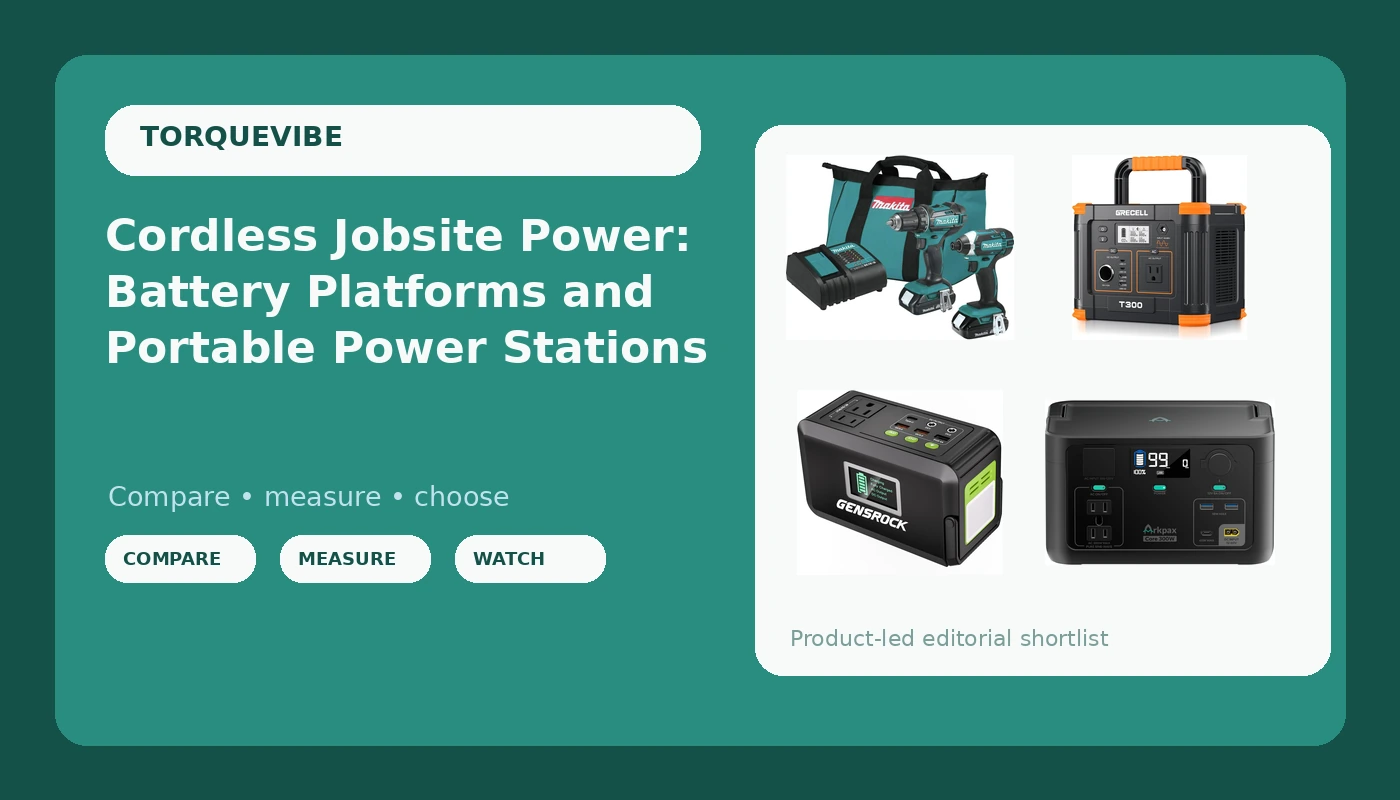
Portable power for cordless tools is two purchases that people keep trying to fold into one. First you buy into a battery platform, and here that platform is Makita's 18V LXT system, where every drill, driver, saw, and light you add for the next decade hangs off one decision. Then you buy whatever keeps those batteries alive when the house you are working in has no live outlets yet, which is where portable power stations come in. On a remodel, the panel gets pulled before lunch and the temporary power does not show up until the electrician feels like it. That gap is where a station earns its keep: charging packs, running work lights, keeping phones and a radio alive. This is an explainer, not a shootout. Below is what the numbers on the boxes actually mean, and which of four options matches the way you work.
Related: How to Pick a Drill Without Marrying the Wrong Battery Platform →
Quick answer
Match the station to the load, not to the biggest number on the box. A portable power station is a lithium battery plus an inverter, and the inverter is the part that limits you. Watts tell you how much load it can push at one moment. Watt-hours tell you how long it can push it. For cordless tool work, the honest job of a station in this class is charging 18V packs, running LED lights, and keeping small electronics alive. None of the three stations here is built to run a circular saw, a table saw, or a shop vac, and none of them replaces a generator when the job gets big. The Makita kit is the tool side of the equation. The stations are the AC side.
Four useful options
| Model | Best fit | What stands out |
|---|---|---|
| Makita CT225SYX 18V LXT Compact 2-Pc. Combo Kit (1.5Ah) | The tool side of the setup, on a long-running 18V platform | 18V LXT system, two tools, compact 1.5Ah batteries |
| GRECELL Portable Power Station 330W, 230.88Wh Solar Generator | Charging packs and running lights through a full remodel day | 330W continuous output and 230.88Wh, the largest stated watt-hour figure of the group |
| Portable Power Station 300W, 600W Surge Solar Generator 192Wh | Small electronics plus a charger or two, with motor headroom | 300W continuous with a 600W surge rating and 192Wh capacity |
| GENSROCK Portable Power Station 120W, Power Bank with AC Outlet 24000mAh | Phones, laptops, and small devices carried in a bag | 120W output and an AC outlet in a power bank format |
The tool side: Makita CT225SYX 18V LXT Compact 2-Pc. Combo Kit (1.5Ah)
The platform is the real purchase, and it matters more than anything printed on a station. An 18V LXT kit puts you on a system with a long production history, which is what you care about in year six when a battery quits and you need a replacement rather than a new family of tools. The 1.5Ah packs in this kit are the small ones. They keep the tools light, they charge quickly, and they run down sooner than the larger packs, which means more charge cycles across a week of work. That is exactly the workload a power station handles well: topping packs back up between tasks when there is no outlet within a hundred feet.
The jobsite station: GRECELL Portable Power Station 330W, 230.88Wh Solar Generator
The math on any station starts with capacity divided by load. Take the stated watt-hours, divide by the watts you are pulling, and you get a rough runtime in hours, then knock some off for inverter losses and for the fact that you rarely get a full discharge out of a pack. What that means in practice is that a 330W station with 230.88Wh is a charging and lighting tool, not a power source for anything with a heating element or a big motor. Its advantage over the smaller options is headroom: a charger, an LED light, and a phone running at once is a comfortable load instead of a fight. Panels are usually sold separately from stations like this one, so factor that in if off-grid recharge is the plan. Solar charging is slow, and it supplements wall charging rather than replacing it.
The middle station: Portable Power Station 300W, 600W Surge Solar Generator 192Wh
Surge is the number people skip, and it is the one that decides whether a station trips offline the moment you plug something in. Motors pull a hard spike of current for a fraction of a second when they start, and an inverter that can only hold its continuous rating will shut down rather than ride that spike out. A 300W continuous rating with 600W of momentary headroom gives you twice the ceiling for that instant. The 192Wh capacity sits between the other two stations. For cordless tool work, surge matters most for the accessories around the tools: a small fan, a pump, a compressor, or whatever else gets dragged onto a job that has no power yet.
The bag-sized one: GENSROCK Portable Power Station 120W, Power Bank with AC Outlet 24000mAh
Two things to understand about this one. First, the 120W ceiling is the smallest of the three stations, which puts a hard limit on what the AC outlet can feed. A phone, a headlamp, a radio, a laptop, and a couple of USB devices are all fair game. Anything with a motor or a heating element is not. Second, capacity is stated in milliamp-hours rather than watt-hours, and those two figures are not directly comparable without knowing the voltage the milliamp-hour rating was taken at. That is a shopping problem rather than a product flaw: you cannot line 24000mAh up against 230.88Wh on a spec sheet and declare a winner. Treat this as a power bank with an AC outlet, which is what it is, and it makes sense in a bag where a bigger station would never come along.
Prices and availability may change. Product images, names, and retailer links are matched to verified listings. No current price, rating, stock status, or measured result is stated here without current evidence.
Watts, watt-hours, and the numbers that matter
Watts are an output ceiling. A 300W station can supply 300W of load at one time, and a 120W station can supply 120W. That ceiling has nothing to do with how long the station lasts, which trips up almost everybody buying their first one.
Watt-hours are capacity, and they set runtime. Divide the stated watt-hours by the watts you are pulling and you get a paper estimate. A 192Wh station feeding a 50W load works out to under four hours on paper, and less in the real world once inverter losses and partial discharge are accounted for. That is arithmetic on the listed numbers, not a tested result, but it is close enough to plan a morning around.
Surge ratings cover the first fraction of a second of a motor start. Continuous ratings cover everything after that. If a listing shows one number only, assume it is the continuous rating and that the inverter has little tolerance for a hard start.
Milliamp-hour ratings need context. A 24000mAh figure is quoted at some cell voltage, and without that voltage you cannot convert it to watt-hours and compare it against the other stations. Watt-hours are the honest unit for cross-shopping.
One more thing worth checking on any listing: whether the AC output is pure sine wave. Chargers, motors, and sensitive electronics are happier on a pure sine wave output, and it is the specification that separates stations built for tools and appliances from stations built for phones.
Finally, keep the two jobs separate in your head. A cordless tool runs on DC power from its own pack. The station never drives the tool. It supplies AC to the charger that refills the pack, which is a much smaller and steadier load than the tool itself.
How to size a station to your tool platform
The right station is the smallest one that covers the loads you will actually put on it. Work through these five steps before you buy.
- List what runs at the same time. One 18V charger, one LED work light, and a phone is a realistic remodel load. Add them up.
- Read the continuous watt rating first, then the surge rating. Continuous is the number you live inside all day.
- Convert capacity into runtime. Divide stated watt-hours by your total load in watts, then discount the result for losses.
- Check what recharges the station and how fast. Wall charging is the workhorse. Panel charging is a supplement, and panels are often sold separately.
- Decide where it lives. A station that stays on the truck can be bigger and heavier. A station that goes in the bag has to be small enough to actually carry.
Keeping 18V packs charged when the power is out
- Charge packs during the work, not after it. Topping up a compact pack between tasks beats waiting until everything is dead at 4 p.m.
- Keep one pack in the tool and one on the charger so you are never standing around waiting.
- Recharge the station itself while the truck is running or over lunch, and avoid running it to zero on purpose.
- Keep lithium packs and the station out of the cold. Capacity and charge acceptance both suffer in a Cleveland January.
- Match the station to the smallest job you do. When the work needs a circular saw or a table saw all day, that is a generator conversation, not a station conversation.
Which option should you choose?
Choose the Makita CT225SYX 18V LXT Compact 2-Pc. Combo Kit (1.5Ah) when you are buying into the tool platform and want two cordless tools on a system with a long production history. Choose the GRECELL Portable Power Station 330W, 230.88Wh Solar Generator when you need the most continuous output and capacity of the three stations for charging packs and running lights across a full day. Choose the Portable Power Station 300W, 600W Surge Solar Generator 192Wh when you want surge headroom for small motor-driven accessories alongside your charging load. Choose the GENSROCK Portable Power Station 120W, Power Bank with AC Outlet 24000mAh when the priority is something small enough to carry every day for phones, laptops, and small devices.
A caveat worth stating plainly: output and capacity figures come from the listings, not from a bench test, and runtime depends entirely on what you plug in. Verify current specifications and included accessories on each product page before you commit, and do not assume a solar panel is in the box.
The bottom line
Buy the platform first and the power source second. The Makita 18V LXT kit is the decision that outlives everything else in this article, because the batteries and tools you add later all hang off it. The stations are the support act: the GRECELL unit carries the most output and capacity for a working day, the 300W station brings surge headroom for small motors, and the 120W power bank is the one that actually travels. None of them replaces a generator, and none of them is meant to. They keep your packs charged, your lights on, and your phone alive until the temporary power shows up.