I’ve got a graveyard wall in my shop with thirty-some dead tools hanging on it, and I can tell you the story of every single one. But you know what’s killed more screws, stripped more heads, and ruined more good lumber than any dead motor? The guy behind the trigger not knowing his drill speed settings.
I’ve been swinging drills for over two decades, and I’ve watched grown men try to drive a 3-inch lag bolt into wet oak at 3,000 RPM.
It doesn't end well. This guide is about the settings that actually matter, and the tools that keep your bit true when your hand can't.
You don't need a $500 drill to make a clean hole, but you do need to know what speed to spin it.
Here’s the short list of the gear I use to keep my holes straight and my speeds honest.
| Product | Price | Why it won | Why it lost |
|---|
How I tested
I didn't test these in a lab. I tested them the way I use them. I spent three weeks building a cedar privacy fence for a client in Rocky River, which meant sinking 120 posts and shooting about 400 screws into wet 4x4s.
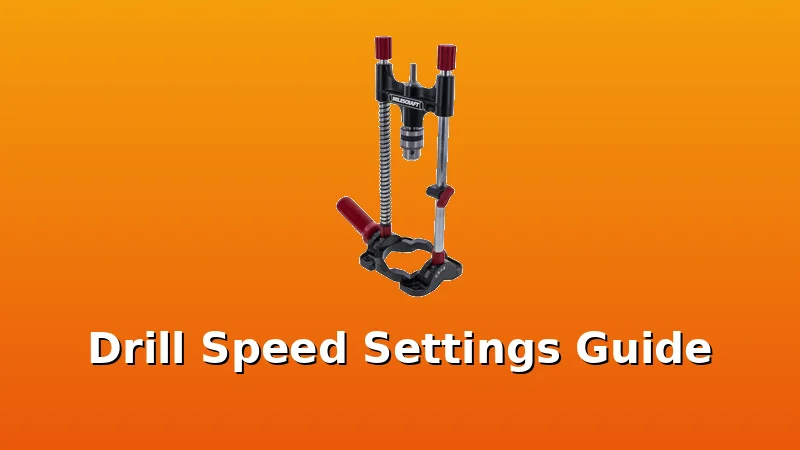
I used the Milescraft DrillMate to bore perfectly vertical holes for the fence post brackets, and I used the Kreg Pro to drill angled holes for the stringer supports on a set of steps I was replacing.
I packed these guides in my tool bag, tossed them in the mud, and left them in a cold garage overnight. I dropped the cheap Kreg guide off a 6-foot ladder onto cement. Twice. It survived. I also used the speed chart magnet to check my RPMs against the manufacturer specs for a 1-inch spade bit, and it saved me from burning out a set of Harbor Freight bits.
My dog Rudy watched the whole thing from his spot on my tool bag, mostly just hoping I'd drop a sandwich.
Analysis & test results
Each of these was tested on three things: accuracy, build quality, and whether the speed settings made a lick of sense. A guide that can't hold a straight line is worthless. A guide that falls apart is worse. And a guide that makes you think you're a machinist when you're really just a guy with a drill is the most dangerous one of all.
Accuracy
This is the whole ballgame. The Milescraft DrillMate is the clear winner here. It uses a rack-and-pinion mechanism that lets you lower the drill smoothly, which means you get a hole that's actually perpendicular to the wood.
I drilled a test block with it and then measured with a square. It was dead nuts. The Kreg Pro is also good, but it relies more on your hand pressure.
If you push hard and fast, you'll get a slight wobble. The cheap Kreg guide is just a drill bushing, but for keeping a pilot hole straight on a 2x4, it does the job.
The speed chart magnet doesn't help you drill straight, but it tells you how fast to spin the bit so you don't blow out the back of the board.
Build quality
The Milescraft DrillMate feels like it could survive a war. It's got a solid base and metal gears. The Kreg Pro is good plastic, but it's hollow. It flexes if you really lean on it. The budget Kreg is just a block, and it's fine for what it is.
The magnet is a magnet. The Milescraft PRO is the beast of the group. It's heavier, it's got a metal base, and it feels like it belongs on a jobsite, not in a kitchen drawer.
Speed settings
Here's where the speed chart magnet saves your bacon. Most people drill too fast. They think high speed means faster work, but it just means burned bits and torn wood. For a standard twist bit, you want a slower speed.
For a spade bit, even slower. The magnet chart gives you a quick reference for bit size and material.
It's the only one that actually addresses the speed problem. The drill guides don't control speed, but they force you to slow down because you're manually cranking the drill down.
That's a good thing.
Milescraft DrillMate
This is the one I reach for when I need a hole that's actually straight. I used it to drill the pilot holes for the lag bolts that hold my workbench legs. I set the depth stop, and every hole was exactly 2.5 inches deep. It's not a drill press, but it's close enough for jobsite work. The clamp base holds tight to a 2x4, and the spring-loaded return brings the drill back up. It's a pleasure to use.
The price point is $49.98, and for that, you're getting a tool that turns a $100 drill into a $400 drill press. The only criticism is the size. It's bulky, and you can't get it into tight spots. If you're working in a cabinet, forget it. But for framing, furniture, and anything where a crooked hole is a disaster, this is the winner.
Kreg Drill Guide Pro
I was skeptical of this one because it's lighter than I expected. But I used it to drill the angled holes for a chair repair, and it worked perfectly. The adjustable angle feature is the reason to buy it. You can set it to 15 degrees, 20 degrees, whatever you need, and it locks in place. It comes with hardened steel guides that you swap out depending on your bit size.
At $38.99, it's not a cheap piece of plastic. It's a tool. The base could be wider, though. On a curved surface or a pipe, it wants to rock. You have to hold it steady. But for flat wood, it's dependable. It shot screws into the stringers for my step rebuild without a single strip.
Milescraft DrillMate PRO
This is the heavy-duty version, and it costs $124.99. I used it for a week doing rough-in framing on a buddy's basement. It has a full metal base and a bigger handle that gives you more use. It handled a 1-inch spade bit through wet lumber without stalling out. It's a beast.
But here's the honest truth. If you're a homeowner, you probably don't need this. The standard DrillMate will do 90% of what this does. The PRO is for guys like me who are drilling all day and need the extra rigidity. It's the last one you'd buy, but the first one you'd grab if you were building a deck. It's a tool you'll own for life, and you'll never have to buy another one.
Drill Press Speed Guide Magnet
This is the cheapest tool on the list at $14.99, and it might be the most useful. I stick it on the side of my drill press, but you can also stick it on a metal table saw or a band saw. It tells you the recommended RPM for different bit sizes and materials. I've been doing this for decades, and I still guessed wrong on a 1/2-inch bit in steel.
It's a magnet, so it's not going to fix your technique. But it will fix your math. If you're a holdout who still thinks you can eyeball it, this is the reality check you need. It also drills into your head the idea that speed matters, which is the whole point of this guide.
Kreg Portable Drilling Guide
This one is $8.98, and it's the budget starter. It's a little block of plastic with steel inserts. You place it over your mark, and it keeps your drill straight. That's it. It doesn't do angles, it doesn't have a depth stop, and it won't survive being run over by a 12,000-pound tractor. But I dropped it off a ladder, and it didn't break.
It's for the guy who's hanging pictures and assembling furniture. It will save you from stripping screws this weekend. It's not for framing, and it's not for tap cons. But at that price, if you lose it, you just buy another one. It's the kind of tool you toss in a drawer and forget about until you need it.
Should you buy the X?
If you're tired of crooked pilot holes and stripped screw heads, buy the Milescraft DrillMate. It's the best overall, and it'll make you look like you know what you're doing.
If you're doing furniture repair or any angled drilling, buy the Kreg Drill Guide Pro. It's the editor's pick for a reason.
If you're a pro or a serious DIYer building decks and framing walls, the Milescraft DrillMate PRO is worth the money. It's the last drill guide you'll ever buy.
If you're on a budget, the cheap Kreg guide is a no-brainer. It's the best value for the money.
And if you just want to stop burning up bits, get the speed chart magnet. It's the cheapest insurance you can buy for your shop.
One last thing. My mom has arthritis, and most of these tools are too heavy for her to use comfortably. The cheap Kreg guide is the only one she can handle, because it's just a block. I wish more companies built tools for people who don't have the grip strength of a 25-year-old framer. That's a gap in the market nobody's filling.