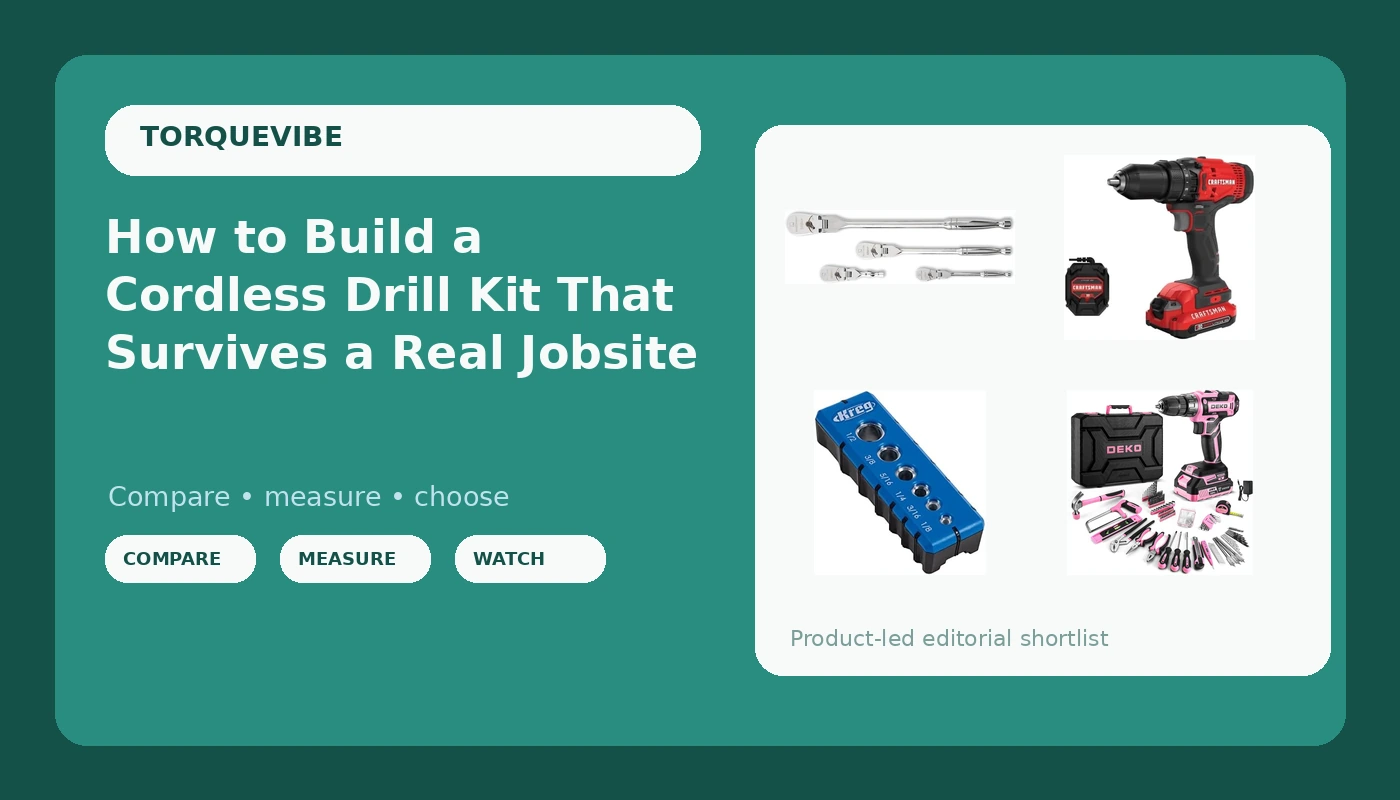
Every week somebody asks me which drill to buy, and every week they expect a number. Torque on the box, RPM on the spec sheet, a star rating on a listing. None of that is the question. A cordless drill and driver kit is a system: the tool itself, the battery platform it locks you into for the next decade, the bits that fit the chuck without wobbling, and the accessories that decide whether your holes land square or wander off the mark. Buy the system wrong and a decent drill will still frustrate you every Saturday. Buy it right and a modest kit will handle years of real work. Here is how the pieces fit together, and which of them you actually need first.
Related: Brushless vs Brushed Drills: What Survives a Season →
Quick answer
Match the tool to the job instead of chasing the biggest number on the box. For general drilling and driving, a 1/2-inch cordless drill/driver kit with the battery and charger included is the most flexible place to start. A compact 20V drill and driver set that comes in its own case suits lighter work and small-space storage. A portable drilling guide is the right answer when the problem is keeping the bit perpendicular to the surface, which no drill solves on its own. A flex head ratchet set covers the bolted fasteners in tight corners where a battery tool simply will not reach. Most people end up needing two of these categories, not one.
Four useful options
| Model | Best fit | What stands out |
|---|---|---|
| CRAFTSMAN V20 Cordless Drill/Driver Kit, 1/2 inch, Battery and Charger Included (CMCD700C1) | General drilling and driving, first cordless kit | 1/2-inch chuck, battery and charger in the kit |
| Pink Power Drill Tool Kit Set: 20V Cordless Electric Drill, Driver, Tool Box with Battery | Light household drilling and driving | 20V cordless drill and driver with a battery, stored in a tool box |
| Kreg Portable Drilling Guide, 6 Hardened Drill Guides, KDG-6000 | Square, repeatable holes in shelves and stock | Six hardened drill guides in a portable body |
| GEARWRENCH 4 Piece 1/4", 3/8" & 1/2" Drive 120XP™ Flex Head Ratchet Set | Hand-tool fastening in tight spaces | Four flex head ratchets across three drive sizes |
The drill/driver kit to start with: CRAFTSMAN V20 Cordless Drill/Driver Kit
The 1/2-inch chuck is the detail that matters most here, because it is the size that accepts the widest range of shank diameters, from a small pilot bit up to a 1/2-inch spade or auger. The kit format means the battery and charger arrive with the tool, so there is no second purchase standing between you and the first hole. This is the drill I would hand to someone buying their first cordless tool who does not yet know everything they will ask of it. The trade-off is the platform commitment. Whatever battery this kit uses is the battery your next tool will use, so if you already own tools from another line, think carefully before adding a second platform to the shop. One platform, one charger, one set of spares is the cheaper life.
The compact kit for lighter work: Pink Power Drill Tool Kit Set
Not every job deserves the good drill. Pilot holes for cabinet hardware, flat-pack furniture, a shelf bracket in a closet, a curtain rod into a stud: that is light duty work, and a compact kit handles it without dragging a full-size tool out of the truck. The case matters more than people admit. A kit that lives in its own box gets used, and a loose drill rolling around a drawer does not. The honest trade-off is capacity. A lighter drill and driver set is at its best on small bits and modest fasteners, and it is not the tool you reach for when you are boring large holes through wet lumber all afternoon. Buy it as the second drill, or as the only drill for a small apartment and a short list of projects.
The accuracy tool: Kreg Portable Drilling Guide
The most common reason a hole goes wrong is not the drill. It is the angle. Drilling freehand, the bit walks across the surface before it bites, the hole ends up oval, and the screw head sits proud on one side of the joint. A guide like this one clamps the bit square to the face and keeps it there, which is the difference between a shelf that sits flat and a shelf you shim. Six hardened guides cover the common bit diameters, so you are not hunting for a bushing every time you change bits. The trade-off is that this is a bench and cabinet tool, not a framing tool. It is for the work where a straight hole matters more than speed, and it earns its place the first time you drill a row of shelf pins by hand.
The hand-tool option: GEARWRENCH Flex Head Ratchet Set
Sooner or later the fastener is a bolt, not a screw, and it is sitting in a corner where no cordless tool will fit. That is the moment a ratchet set stops being optional. Four ratchets across three drive sizes cover everything from small machine screws up to the hardware under a deck ledger, and the flex head lets the handle swing away from the work so your knuckles stay where they belong. Sockets and extensions are a separate purchase, so budget for those alongside the set. The honest trade-off is that hand tools cost arm strength instead of battery charge, and for a long run of bolts an impact driver will still beat you. But for the last stubborn fastener in a tight corner, this is the tool that finishes the job.
Prices and availability may change. Product images, names, and retailer links are matched to the correct product record. Do not state a current price, rating, stock status, or measured result without current evidence.
What separates a drill from a driver
People use the words interchangeably and then wonder why one tool keeps slipping. A drill has a three-jaw chuck that closes on round shank bits, which is what you need for twist bits, spade bits, hole saws, and anything that bores a hole. A driver, or the driver mode of a drill/driver, holds 1/4-inch hex shank bits in a quick-release collet so you can swap bits one-handed. The clutch is the collar behind the chuck that stops the tool from turning at a set torque, and it is the single most useful control on the tool. Set it low and you can run screws into drywall without burying the head. Set it high and you can drive a structural screw. Learn the clutch before you learn anything else, and you will stop stripping screws this weekend.
The other half of the equation is the battery platform. Torque figures on a box are measured under ideal conditions, on a fresh charge, with a motor at operating temperature. What you actually get on screw 150, with a tired arm and a cold morning, is a different number, and no spec sheet will tell you what it is. What a spec sheet will tell you is which batteries fit, and that is the number that matters for the next ten years. Every tool you buy on the same platform shares chargers and packs. Every tool you buy on a new platform starts the spending over.
Five steps for choosing your setup
- Write down the last five things you actually drilled or drove. Real projects, not hypothetical ones.
- Decide whether you need a hole, a driven fastener, or a square hole. Those are three different tools.
- Pick the battery platform before you pick the tool, and count how many tools you expect to own on it.
- Check the chuck size against the largest bit you plan to use. A 1/2-inch chuck covers the widest range.
- Buy the accessories with the tool, not after it. Bits, sockets, and guides are what make the tool useful.
Practical guidance
- Set the clutch low for small screws and raise it only when the tool stalls, not when you get impatient.
- Let the bit do the work. Pushing harder overheats the motor and rounds the screw head at the same time.
- Keep a set of sharp bits on hand. A dull bit is the real reason most holes come out ugly.
- Start every hole with a pilot bit and a punch mark, and the bit will not walk across the surface.
- Store the drill with the battery off the tool and the chuck closed, and it will still be there when you need it.
Which option should you choose?
Choose the CRAFTSMAN V20 Cordless Drill/Driver Kit when you want one cordless tool that covers general drilling and driving, with the battery and charger already in the box. Choose the Pink Power Drill Tool Kit Set when your work is light duty and you want the drill and driver stored together in a case. Choose the Kreg Portable Drilling Guide when straight, perpendicular holes in shelves and cabinet parts matter more than raw power. Choose the GEARWRENCH Flex Head Ratchet Set when the fastener is a bolt in a tight corner and no cordless tool will reach it.
These four products do different jobs, so they are not substitutes for one another, and none of them is a substitute for checking the current listing before you buy. Availability, included accessories, and battery compatibility can change, and the listing is the only place to confirm what actually ships in the box.
The bottom line
Build the kit around the work, not the spec sheet. A 1/2-inch cordless drill/driver kit with the battery and charger included covers the widest range of everyday drilling and driving, a compact 20V drill and driver set handles light duty and stores in its own box, a portable drilling guide fixes the angle problem no drill can fix alone, and a flex head ratchet set covers the bolted fasteners in tight spaces. Buy the battery platform once and stay on it, learn the clutch, and keep sharp bits in the case. That is most of what separates a tool that lasts from one that ends up on a shelf.