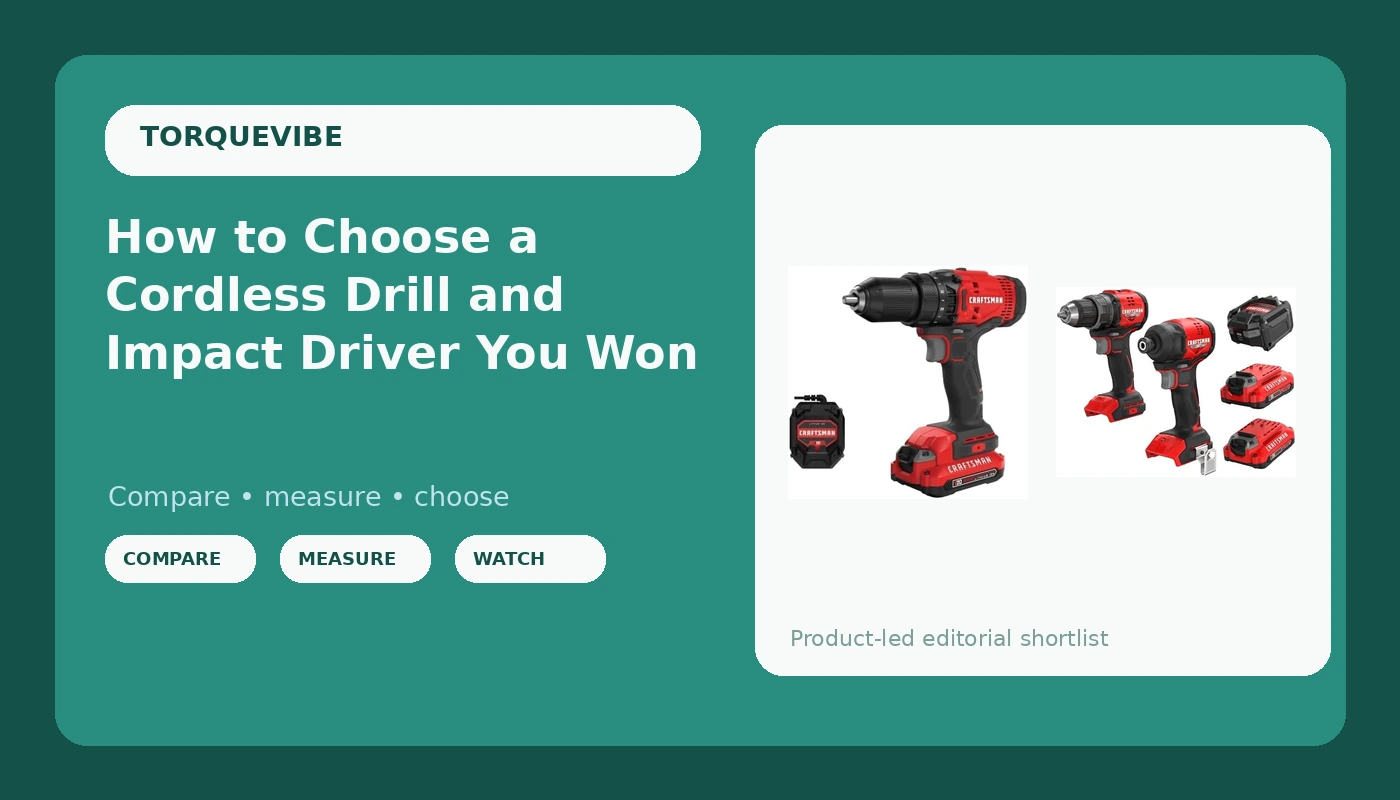
Most people buy a cordless drill and impact driver the way they buy a toaster: walk the aisle, find the number that looks biggest, and hope. Then the chuck slips on the third deck screw, the battery quits at screw 150, and the tool spends the rest of its life in a drawer next to a dead flashlight. I have watched that happen on my own crews for 22 years, and I have got the wall in my shop to prove it.
The two kits below are the ones I would hand a homeowner or a first-year apprentice without flinching. The rest of this article is the part nobody teaches: how to set the tool up, how to run it so you are not fighting it, and how to keep it alive long enough that the money made sense.
There is no secret. There is a clutch collar, a bit that matches the screw, and a battery that gets treated better than your phone.
Why you should trust me
I ran a general contracting crew in Cleveland for 22 years. Decks, basements, kitchens, the whole rusty Midwest menu. The graveyard wall in my shop has 30-some dead tools on it, and every one of them earned its spot: smoked brushed motors, a chuck that stripped its own jaws, a hammer drill that caught fire mid-pour.
That wall is why I do not review tools off a spec sheet. Nothing gets a recommendation from me without a 200-screw rundown, a torque reading at screw 200 instead of screw 5, a timed battery rundown from full charge to dead, and 200 bit changes to see whether the chuck still bites. If I have not dropped it off a ladder once, I have not tested it.
I am not going to pretend a $99 kit is a Milwaukee. What I will tell you is exactly what a cheap kit can and cannot do, and how to keep one running far longer than the price tag suggests it should.
How I picked, and what I refuse to ignore
A drill is a motor, a chuck, a trigger, and a battery interface. Everything else is plastic and marketing. When I sort a shelf of drills, these are the things that decide it:
The chuck. A three-jaw keyless chuck that slips under load is a tool that lies to you. It slips, the bit spins, you round off a screw head, and now you are drilling it out. That is a 20-minute tax on a 30-second job. I do not care what the box claims about torque if the jaws will not hold a 1/2-inch spade bit in wet lumber.
Brushless or brushed. Brushless is not a marketing word. It is the difference between a tool that lasts a season and a tool that lasts a decade, because there are no carbon brushes to wear down to nothing. It also runs cooler and gets more runtime out of the same battery.
The battery platform. This is the real purchase. Ten years from now you are still married to whatever battery system you buy into, so the question is not "is this drill good," it is "will I still be able to buy batteries and a charger for this thing in five years."
Weight and balance. A drill that is front-heavy will wear your wrist out by screw 60. The tool should balance right behind the trigger, not out at the chuck.
Parts availability. Can you buy a replacement chuck, a trigger switch, a new charger? A tool you can repair is a tool you keep.
The two kits worth your money
Two different buyers, two different answers. If you own one drill and you use it eight times a year, you need the first one. If you are building anything bigger than a bookshelf, you need the second one.
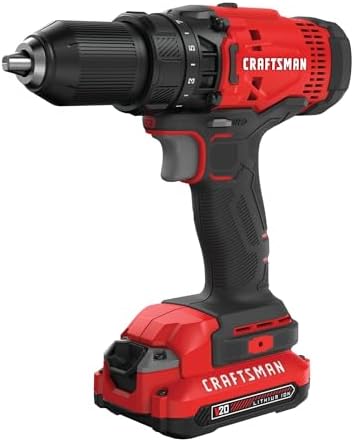
Budget pick: CRAFTSMAN V20 Cordless Drill/Driver Kit, 1/2 inch, Battery and Charger Included (CMCD700C1)
 Visit on Amazon →
This is the one-drill household kit. It is a 1/2-inch drill/driver, it comes with the battery and the charger in the box, and it runs on the V20 platform, which matters more than anything else on this page. The 1/2-inch chuck is the size you want, because it takes every bit you will ever need, including the big spade bits and hole saws that a 3/8-inch chuck will not hold.
Here is my honest read on it: this is a brushed drill, and brushed drills die. That is not a knock on this specific kit, it is how brushed motors work. Carbon brushes wear down, the motor runs hotter, and one Friday afternoon it just stops. For hanging curtains, assembling furniture, driving a couple hundred screws a year, and drilling pilot holes in pine, it will do the job for years. For a deck build, it is the wrong tool and no amount of wishful thinking changes that.
Buy it if you want one drill that lives in a closet and comes out when something needs a hole. Treat the clutch collar with respect, do not stall the motor against a stuck bit, and it will surprise you.
Flaws but not dealbreakers: Brushed motor, so runtime per charge and total lifespan are both shorter than a brushless tool. It is also a single-tool kit, which means no impact driver when you hit a 3-inch deck screw.
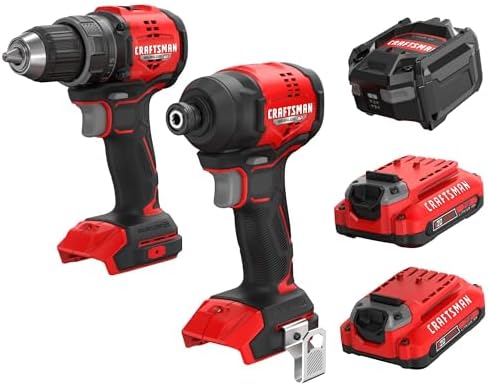
Our pick: CRAFTSMAN V20 Brushless RP Drill Driver and Impact Driver Compact 2 Tool Combo Kit With 2 x 2ah Battery and Charger, 1900 RPM Power Drill, 2100 Torque Cordless Impact (CMCK1411D2)
 Visit on Amazon →
This is the kit I would actually put on a truck. You get two tools instead of one: a brushless drill/driver for holes and controlled driving, and an impact driver for everything that fights back. You also get two 2Ah batteries and a charger, which is the part people underestimate. Two batteries means one is always charged, and that single fact eliminates 90% of the frustration in a homeowner's tool bag.
The box advertises 1,900 RPM on the drill and 2,100 in-lbs of torque on the impact. Remember what that torque number is: it is measured on a warm battery with a fresh charge, in a lab, on a bench. Real torque is what is left after 50 screws and a 40-degree Cleveland morning. What matters is that the impact has a 1/4-inch hex collet instead of a chuck, so bits click in and out with one hand. That is the difference between a tool you enjoy and a tool you curse at every bit change.
Buy it if you are building anything: a fence, a deck, a shed, a basement wall. The impact driver does the screw driving, the drill does the holes, and neither one has to do the other's job badly.
Flaws but not dealbreakers: The two 2Ah batteries are the small ones. They are fine for a homeowner and they keep the kit light, but a full day of deck work will have you wanting a bigger pack. Also, the compact bodies mean less mass to sink a long auger bit, so let the tool spin and do not lean on it.
How to actually run these tools
Now the part that saves you money. Every one of these steps is free, and skipping them is how people kill a drill in six months.
Step one: match the bit to the screw, exactly. A Phillips #2 bit in a Phillips #2 screw head, fully seated, dead straight. A bit that is one size off, or a driver bit worn round at the tip, is what strips screw heads, not the drill. When a bit starts camming out, throw it away. They are consumables.
Step two: set the clutch before the first screw. The clutch is the numbered collar behind the chuck. It slips the drive at a set torque so you do not bury a screw through drywall or snap a head off. Start low, drive a test screw into scrap, and click up one number at a time until the screw seats flush without stripping. For cabinet work, that number is low. For structural screws into framing, run it at the drill setting and let the impact driver take over.
Step three: know when the clutch is off. Most drills have a drill-mode setting past the highest clutch number, usually marked with a drill bit icon. In drill mode the clutch is bypassed and the tool will drive until it stalls. That is what you want for drilling holes. It is not what you want for driving screws into a finished surface.
Step four: give the impact driver the impact work. Anything 3 inches or longer, anything going into pressure-treated lumber, anything with a star or hex head that wants to be tight. The impact driver hammers rotationally instead of just twisting, which is why it drives a deck screw in three seconds without trying to break your wrist. The drill is not a substitute, no matter what the torque number on the box says.
Step five: use the gearbox. Both of these tools have a two-speed selector on top. Low gear is for driving and for hole saws, where you want torque and control. High gear is for small twist bits in wood and metal, where you want speed. Running a hole saw in high gear is how you burn a motor.
Step six: treat the battery like a tool, not a fuel tank. Do not leave a pack on the charger for weeks. Do not store it in a freezing garage over the winter if you can help it. Do not run it dead and leave it dead. Charge it, use it, and when it comes off the tool, put it back on the shelf at room temperature. A 2Ah pack treated well will outlast three packs treated badly.
Step seven: blow the vents out and check the chuck. Sawdust packed into the motor vents is a slow death. A blast of compressed air every few months keeps the motor cool. And once a month, chuck a bit and try to wiggle it side to side. If the jaws have play, the chuck is on its way out, and a slipping chuck is a tool that lies.
The competition and why it lost
If you have read anything else I have written, you know where I land on the big platforms. Milwaukee M18 Fuel is the best overall for pros. It is the only drill I have never had come back from a jobsite with smoke coming out of it. DeWalt XR is the best value for serious work, a little less brute force than Milwaukee but the best price per year of service in the business. Makita is the smoothest, with the best chuck feel and trigger control in the industry. Ryobi's brushed line dies fast, but the brushless HP tools are legitimately fine for the price. Bosch builds the most compact drills for tight spaces, even if the battery lineup lags the big two.
Those are different articles, and different budgets. This one is about the two Craftsman kits, and here is the honest caveat I owe you: Craftsman is not DeWalt's little brother, and anyone who tells you it is has not run one hard. What the V20 platform does give you is a cheap entry point, wide battery availability, and a tool that will absolutely do homeowner work. What it does not give you is a ten-year pro-grade marriage.
If you are framing a house for a living, buy into Milwaukee or DeWalt and cry once. If you are building a deck with a buddy on a Saturday, the brushless combo kit will finish the job and still be on your shelf in five years.
What this all costs
I am not going to print prices, because they move every week and a stale number is worse than no number. Check current Amazon price on both listings before you buy, and check it again around the holidays, because the combo kits are the ones that get cut hardest.
The real cost math is not the sticker. It is this: the single-tool kit is the cheapest way into the V20 platform, and the two-tool brushless kit is the cheapest way into a brushless drill and a real impact driver at the same time. Two batteries in the box means you are not buying a spare in month two. That is where the money actually goes in this hobby, and that is the number worth comparing.
The drill is the first tool you hang on a battery platform. Make sure the platform is one you can still buy into in five years, and make sure the tool in your hand has a chuck that bites, a clutch that clicks, and a motor with no brushes to burn out.
Then set the clutch, let the tool do the work, and stop stripping screws. That is the whole job.