Related: Best Cordless Drill for Deck Building: Torque That Survives Screw 200
Every crooked hole I have ever had to fix started the same way: the bit walked a quarter inch off the mark and the drill followed it. A drill guide for straight holes is the least glamorous purchase in your kit and the one that saves the most material. You can hang a $300 brushless drill on your hip and still bore a wandering hole if the bit starts off axis, and you can still split a rail if the hole is not square to the face.
I ran a contracting crew in Cleveland for 22 years: decks, basements, kitchens, and a whole lot of repair work on other people's mistakes. I have burned out more drills than most people will ever own, and each one ends up on the graveyard wall in my shop. That wall has taught me more about tools than any spec sheet, because nothing gets up there without earning its death.
Straight holes need two things. You need a drill that holds a bit without wobbling, and you need something that keeps that bit perpendicular while it cuts. The four tools below cover both halves of that problem at very different budgets: two cordless drills and two portable guides. What I will not do is quote you a torque number off a box and call it a review. Where I have not put a specific unit through my own deck run, I will tell you what the design does, where it stops, and what to check in your first hour with it.
Best Overall: WORX SwitchDriver 2-in-1
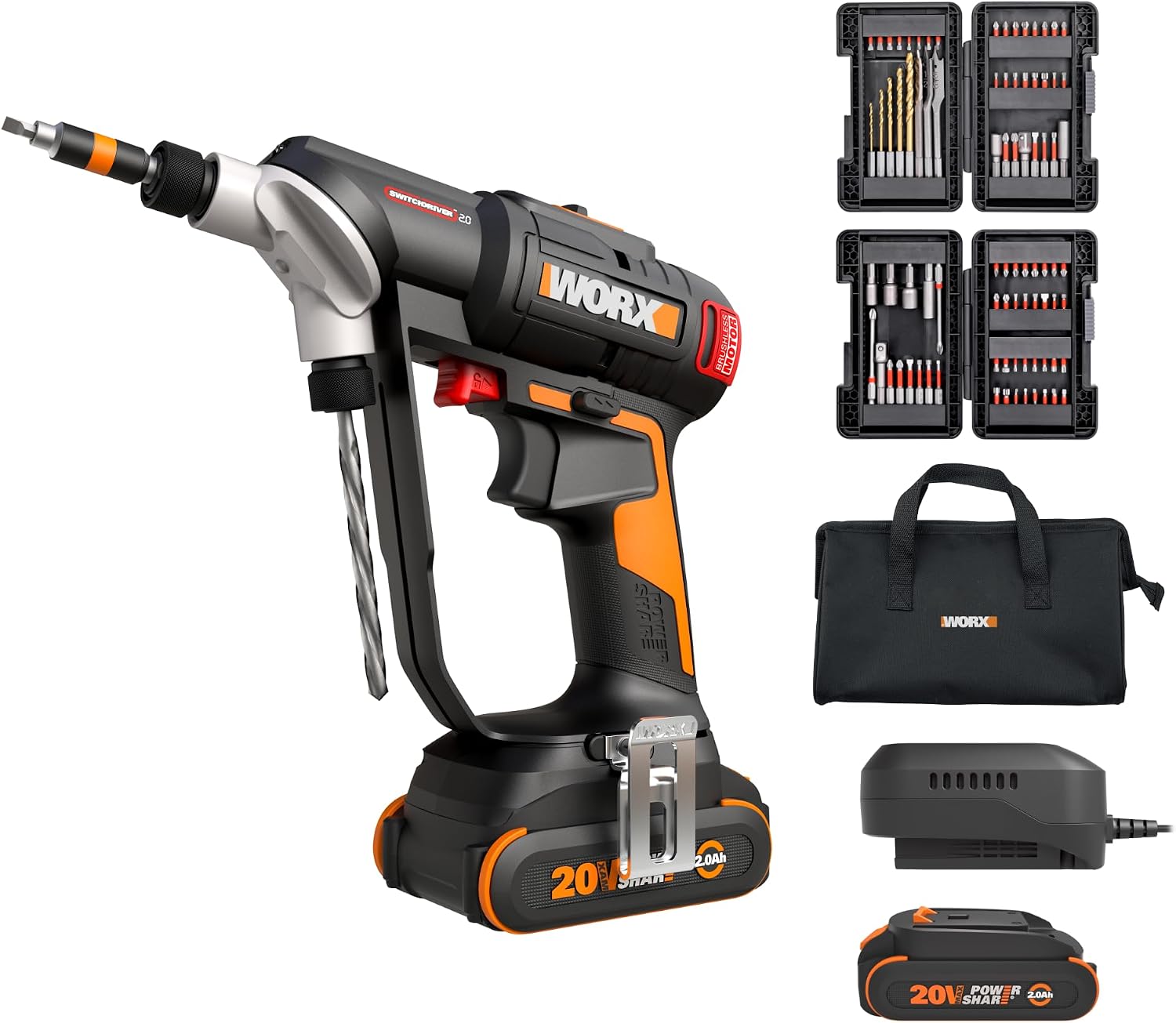
The WORX SwitchDriver is the tool in this group that solves a problem most people do not notice until their hundredth pilot hole: the bit swap. It is a 20V brushless drill driver with two rotating chucks. One holds a drill bit, the other holds a driver bit, and a twist of the collar puts the right one in line. Pilot hole, rotate, drive the screw, rotate back.
For cabinet hardware, hinge plates, and anything where a pilot hole and the screw that follows it happen in one motion, that design earns its keep. Brushless matters here too, and it is not a marketing word. A brushless motor has no carbon brushes to wear down, which means more runtime per charge and more seasons before a tool starts to smell like burnt toast.
Two things to weigh before you buy. First, you are buying into a battery platform, not a drill. The tool is the first thing you hang on that system, and ten years from now you are still married to it, so look at what else runs on those batteries. Second, two chucks mean more mechanism than one chuck. Check both chucks for play the day it arrives and check them again after a hundred bit changes. A chuck that slips is a tool that lies, and I do not care what the box claims.
Best Budget Kit: CRAFTSMAN V20 Cordless Drill/Driver Kit
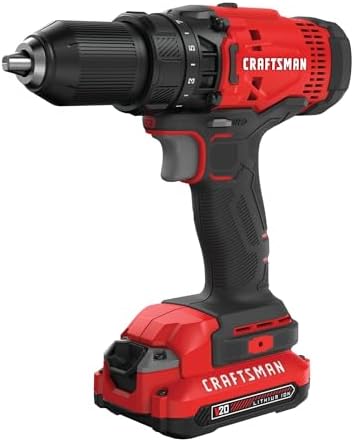
This is the one box answer: a cordless drill driver with a 1/2 inch chuck, plus the battery and charger in the kit. If you are buying your first drill, or you need a second one for a helper who is not getting your good tools, a kit means you are not hunting for a battery system on top of the tool.
The 1/2 inch chuck is the right size for real work. It takes the spade bits, hole saws, and step bits you will actually reach for, and it holds a drill guide's shank without an adapter. A 3/8 inch chuck covers most household jobs, but it will not take a 1/2 inch shank, and the day you need one you are shopping again.
My caution is the same caution I give about every budget drill. The kit name does not tell you whether the motor is brushed or brushless. That one detail is the difference between a tool that lasts a season and a tool that lasts a decade, and it is the first thing to verify before you commit. Then check the chuck jaws for play out of the box, run a bit up and watch for wobble at the tip, and set the clutch low for the first few screws so you learn where it slips. Treat it as a light duty tool and it will do light duty work for years.
Best Portable Guide: Kreg Portable Drilling Guide (KDG-6000)
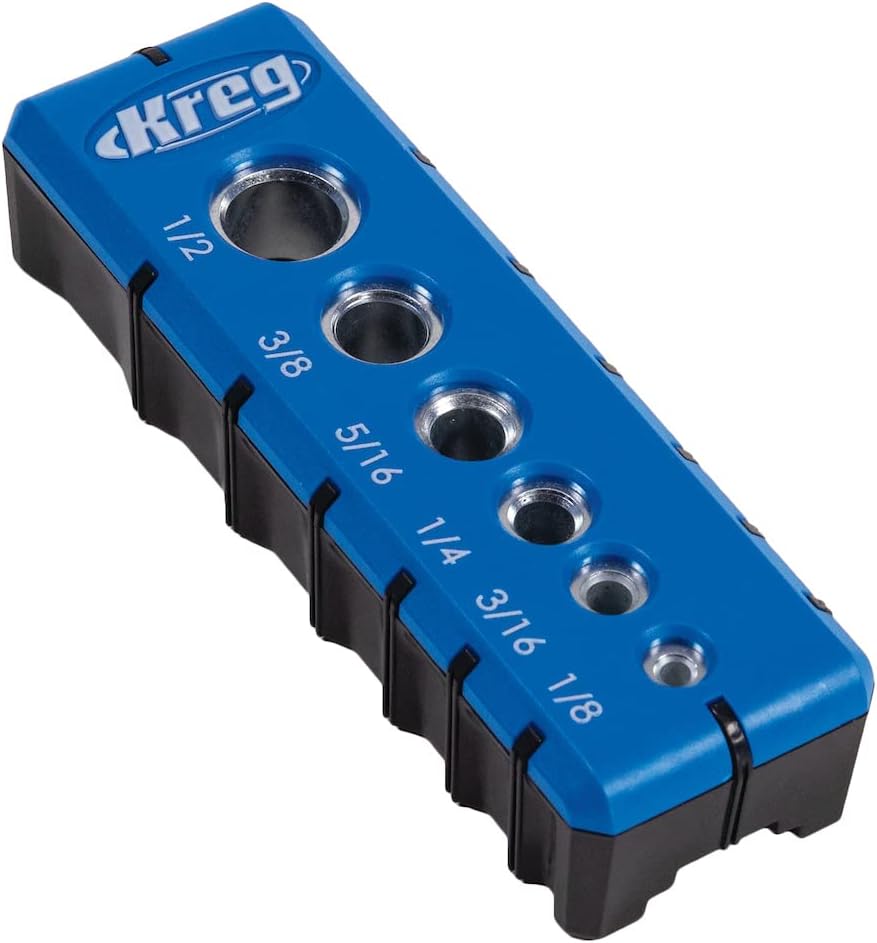
The Kreg KDG-6000 is a handheld guide with six hardened drill guides, and it is built for work you do standing at the bench or kneeling on a floor. A hardened bushing takes the wear instead of your stock, so the bit enters the same way on hole one and hole fifty. Six sizes in one block covers most of what a homeowner or a trim carpenter drills in a day.
Where this kind of guide pays for itself is on edges and faces where a bit wants to skate: shelf pins in a cabinet side, dowel joints, hinge screw holes in a soft pine jamb, pilot holes in a rail where the bit always seems to wander toward the end grain. Hold it flat, clamp it if you can, and let the bushing do the aiming.
Check two things when it arrives. Look at the bushings for burrs, and check that they sit square in the block. Then test the fit of your most common bit. A bushing that is a hair too loose will let the bit tilt a degree or two, and a degree or two is a visible gap in a finished joint.
Best for Round Stock and Corners: Milescraft 1307 Drill Block PRO
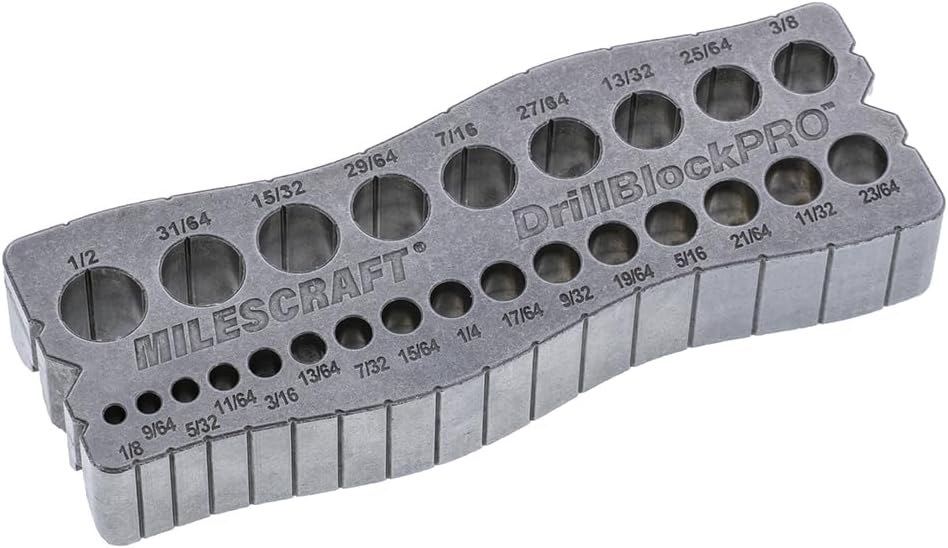
The Milescraft 1307 Drill Block PRO is the shop answer. It is an all metal handheld guide with 25 drill guides in one block, covering 1/8 inch to 1/2 inch in 1/64 inch increments. That range matters more than it sounds. Dowel and pin fits live in those tiny increments, and having every size in one block means you stop hunting for the right bushing in a drawer.
The dual V-groove design is the part I care about. A flat guide on a dowel or a pipe is a guide that rocks, and a rocking guide is a drill bit with an opinion. The V-groove cradles round stock and corners so the block sits still while you drill, which is the whole job of a guide.
Metal construction is the other thing worth paying for here. A guide is a wear item, and a plastic block with metal inserts can go out of square long before the bushings do. Check the block for flatness against a straightedge, check that the V-grooves are machined clean, and clamp the work before you trust any handheld guide with a finish cut.
How I test drills and guides
I do not review tools off a spec sheet, so here is the standard anything on my truck has to meet, and the standard you should hold your own purchases to.
For a drill: 200 screws into wet lumber, with a torque reading at screw 200 rather than screw 5, because a fresh battery and a warm motor flatter any tool. A chuck gets 200 bit changes and a slip check under load before I will call it good. And the whole thing comes off a ladder once, because jobsites are not labs and a tool that cannot survive one drop does not belong in a pouch.
For a guide: I check square against a machined edge, drill a dozen holes in scrap and measure the wander, then check the bushing for wear and the block for flatness. A guide that will not sit flat is a guide that will not drill straight, no matter how many bushings it carries.
Analysis: what actually makes a hole straight
Bit walk is the whole problem. The tip of a twist bit grabs the first soft spot it finds and pulls off the mark, and once the bit is tilted, the hole is tilted, and no amount of wrist strength fixes it. Three things prevent it.
The first is a starting point. A center punch or an awl gives the tip somewhere to sit. On hardwood, a brad point bit does the same job better, because the spur cuts the perimeter before the flutes lift the waste.
The second is a guide with hardened bushings. This is where the Kreg and the Milescraft earn their money. Bushings do not care how steady your hand is. They keep the shank on axis for the full depth of the cut, which is exactly what your wrist cannot do on a ladder.
The third is work holding. Clamp the piece. A guide held by hand on a loose board is a suggestion, not a jig. Half the crooked holes I have seen in finished cabinets were drilled by someone with good tools, a good guide, and no clamp.
One more thing about drills. Chuck runout matters more than torque for clean holes. Put a long bit in the chuck, spin it slowly, and watch the tip. If it describes a circle, the chuck is not holding the bit on center, and every hole you drill with that tool will be slightly oversized. That is a warranty conversation, not a technique problem.
The drill guide reference table
This is the table I keep in my head when someone asks what to buy for straight holes. Pick the row that matches your job, not the row that matches your budget.
| Tool | Type | Best for | Notes |
|---|---|---|---|
 Visit on Amazon → Visit on Amazon →WORX SwitchDriver 2-in-1 |
Cordless drill/driver | Pilot hole and drive in one motion | Brushless motor, two rotating chucks, 20V platform |
 Visit on Amazon → Visit on Amazon →CRAFTSMAN V20 Cordless Drill/Driver Kit |
Cordless drill/driver kit | First drill or a second tool for a helper | 1/2 inch chuck, battery and charger included |
 Visit on Amazon → Visit on Amazon →Kreg Portable Drilling Guide (KDG-6000) |
Portable drilling guide | Edge and face holes on the job | Six hardened drill guides |
 Visit on Amazon → Visit on Amazon →Milescraft 1307 Drill Block PRO |
Handheld drill block | Round stock, corners, dowel and pin fits | 25 guides, 1/8 inch to 1/2 inch in 1/64 inch increments, dual V-groove |
Should you buy the WORX SwitchDriver?
If you drill and drive in the same motion all day, yes. Cabinet hardware, hinges, and trim work are where the two chuck design stops being a gimmick and starts being the reason you finish an hour earlier. Check both chucks for play before the return window closes, and look at the rest of the 20V lineup before you commit to the platform, because that is the ten year decision.
Should you buy the CRAFTSMAN V20 kit?
Buy it if you want one box with everything in it and you are honest with yourself about the work. It is a first drill or a helper's drill, not a jobsite beater. Verify the motor type, check the chuck jaws, and keep your expectations in line with what you paid.
Should you buy the Kreg KDG-6000?
Yes, if your straight hole problem lives on edges, faces, and shelf pins. Six hardened guides in a portable block is the right tool for trim and cabinet work, and it goes where the work is instead of living on a bench.
Should you buy the Milescraft 1307 Drill Block PRO?
Yes, if you drill round stock, corners, or anything where a 1/64 inch fit matters. Twenty five guides in one all metal block is a lot of accuracy for a small outlay, and the V-groove is what makes it work on a dowel.
The bottom line
Straight holes are a system: a bit that starts on the mark, a guide that keeps it perpendicular, and a clamp that holds the work still. Buy the guide first, because it is the cheapest part of that system and the one that fixes the most mistakes. Then buy the drill that fits the batteries you already own, check the chuck before you trust it, and measure your holes instead of eyeballing them. Do that and you will stop buying material twice.