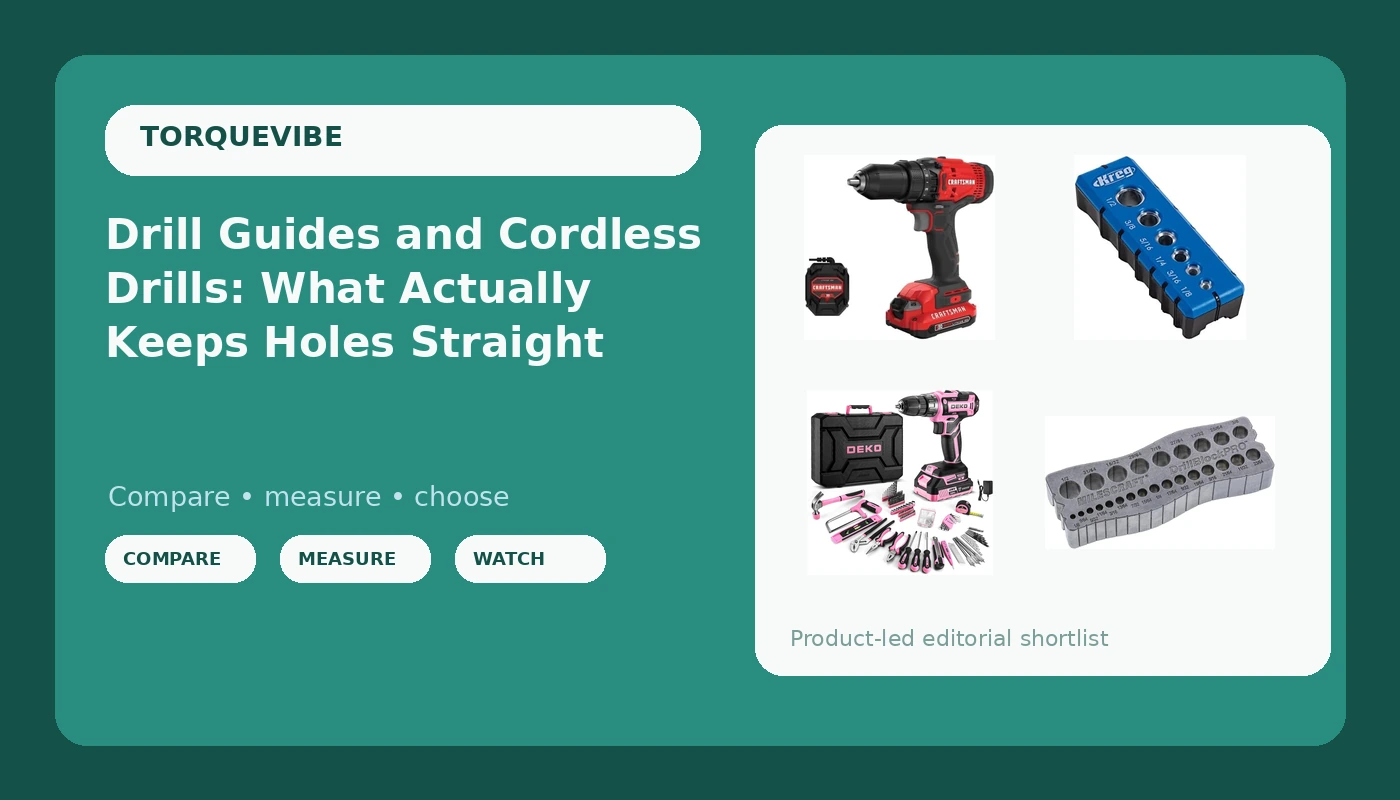
A cordless drill is a motor, a trigger, and a chuck. A drill bit is a piece of sharpened steel. Neither one has any idea what "straight" means. That gap shows up the first time you bore through a dowel, a shelf upright, or the corner of a board and watch the bit skate off your mark before it ever bites. The usual reaction is to blame the drill and go buy a bigger one. The better fix is to match a cordless drill and drill guide to the work in front of you: a drill that holds a bit without slipping, and a guide that holds the drill at the angle you actually intended. The four tools below cover that ground at very different budgets, from a complete starter kit to a handheld block with a guide hole for nearly every bit in a standard index.
Related: Cordless Drill Battery Platforms Explained →
Quick answer
If you do not own a drill yet, start with a complete kit that includes a battery and a charger, because a bare tool with no battery is not a working tool. If you already own a drill and your holes wander, a new drill will not fix that on its own; a drilling guide will. For most home and shop work, the practical combination is one cordless drill/driver kit plus one drilling guide. The CRAFTSMAN V20 kit carries a 1/2 inch chuck, which accepts a wider range of bit shanks than a 3/8 inch chuck does. The Pink Power kit arrives as a boxed set with a battery and a tool box. The Milescraft 1307 Drill Block PRO covers the widest span of guide sizes of the two guides here, and the Kreg guide is built around six hardened drill guides.
Four useful options
| Model | Best fit | What stands out |
|---|---|---|
| Pink Power Drill Tool Kit Set: 20V Cordless Electric Drill, Driver, Tool Box with Battery | A first drill for assembly and light home repairs | Sold as a complete boxed set with a 20V battery, a driver, and a tool box |
| CRAFTSMAN V20 Cordless Drill/Driver Kit, 1/2 inch, Battery and Charger Included (CMCD700C1) | General drilling and driving with standard bits | 1/2 inch chuck, part of the CRAFTSMAN V20 battery platform, battery and charger included |
| Milescraft 1307 Drill Block PRO, All-Metal Handheld Drilling Guide for Straight Holes. 25 Drill Guides in One! 1/8” to 1/2” in 1/64” Increments. Dual V-Groove Design for Round Stock & Corners | Square holes in flat stock, round stock, and corners | All-metal body with 25 guide holes from 1/8 inch to 1/2 inch in 1/64 inch increments and a dual V-groove base |
| Kreg Portable Drilling Guide, 6 Hardened Drill Guides, KDG-6000 | Repeatable holes on installed work | Six hardened drill guides in a portable, handheld body |
The starter kit: Pink Power Drill Tool Kit Set: 20V Cordless Electric Drill, Driver, Tool Box with Battery
A kit like this is aimed at assembly, small repairs, and light drilling around the house. It is not the tool you reach for when you need to spin a large spade bit through wet lumber, and buying a kit means you are also buying into whatever battery that box uses. If you already own batteries from a major platform, a bare tool inside that platform will usually serve you better. If you own nothing and want one box that works this weekend, a complete kit is the faster route.
The 1/2 inch kit: CRAFTSMAN V20 Cordless Drill/Driver Kit, 1/2 inch, Battery and Charger Included (CMCD700C1)
The chuck is the part of a drill that either holds or lies. A 1/2 inch chuck takes bits with a 1/2 inch shank as well as everything smaller, so one drill covers more of the bit index than a 3/8 inch model does. The battery is the longer commitment. Before buying into any cordless platform, ask two questions: how many tools already run on that battery, and will you still be able to buy replacements in five years? A drill is a five-year purchase at best. A battery family is a ten-year one.
The all-metal block: Milescraft 1307 Drill Block PRO, All-Metal Handheld Drilling Guide for Straight Holes. 25 Drill Guides in One! 1/8” to 1/2” in 1/64” Increments. Dual V-Groove Design for Round Stock & Corners
A drill block does one job: it holds the bit square to the surface. Set the block on the work, drop the bit through the hole that matches its size, and the block gives you a plane to work against. It does not clamp, it does not replace a drill press, and it will not correct a bent bit or a worn chuck. What it does is remove the guesswork on dowel joints, shelf pins, and any hole where close enough is not close enough. The V-groove matters more than people expect, because round stock and corners are exactly where a bit wants to skate sideways.
The portable guide: Kreg Portable Drilling Guide, 6 Hardened Drill Guides, KDG-6000
Guides wear. The walls of a guide hole are what keep a bit on line, and hardened steel is what keeps those walls from wallowing out after a few hundred holes. That is the argument for a guide built around hardened inserts rather than holes drilled in a soft body. The trade-off with a portable guide is coverage: a compact body carries fewer sizes, so check the bit sizes you actually use against the guide sizes before you buy.
Prices and availability may change. Product images, names, and retailer links must be matched by verified ASIN. Do not state a current price, rating, stock status, or measured result without current evidence.
Why a cordless drill alone does not drill a straight hole
A drill applies rotation and forward force. Nothing in that pair controls direction. Direction comes from three things: where the bit point touches the material, the angle of the bit relative to the surface, and how steady the hand behind the tool is once the flutes engage.
Bit walk happens because a spinning twist bit is a poor center punch. On a smooth or rounded surface, the point skates before it cuts, and once it has skated, the hole is already off location. Angle drift happens because a hand-held drill is a lever. Any sideways pressure on the body tilts the bit, and the deeper the hole, the more that tilt compounds.
Chuck quality matters for the same reason. A chuck that does not hold the shank on center sends the bit down a slightly different axis on every rotation, which is why a slipping chuck produces an oversized, out-of-round hole rather than a clean one. This is also why 3/8 inch and 1/2 inch chucks behave differently with large bits: the bigger chuck holds a bigger shank, and a bigger shank resists deflection better.
None of that is solved by more torque. It is solved by controlling the angle and the starting point.
What a drilling guide actually does
A guide is a hole of a known size in a body you can hold flat or square against the work. The bit passes through it, and the wall of that hole constrains the bit's angle. That is the whole trick.
It does not add torque. It does not make a cheap bit cut straighter. It removes one variable: your ability to hold an angle by eye. Two design details matter when you are comparing guides.
The first is the range of guide sizes. A block with 25 holes from 1/8 inch to 1/2 inch in 1/64 inch increments covers the common drill index. A guide with six sizes covers fewer, so you match it to the bits you own.
The second is how the body sits on the work. A V-groove lets one block register on round stock and on corners, where a flat-bottomed block would rock.
- Measure the hole you actually need and write down the bit size. Guide coverage is sold by bit size, not by project.
- Check the chuck on your drill. A 1/2 inch chuck accepts the full range of common shanks; a 3/8 inch chuck limits you to smaller bits.
- Decide whether you are buying a first drill or a second one. If it is the first, buy a kit with a battery and charger. If it is not, buy a bare tool inside the battery platform you already own.
- Decide where the work happens. Bench work on flat stock favors a block with wide size coverage. Work on installed material favors a portable guide you can carry to the workpiece.
- Buy the guide before you buy the bigger drill. Wandering holes are an alignment problem far more often than they are a power problem.
Practical guidance before you buy
- Buy into a battery platform once, then buy bare tools inside it. The drill is the cheap part; the batteries are the marriage.
- Match the guide to the bits you already own rather than to the bits you plan to buy someday.
- Keep a brad-point or pilot bit for the first bite. A guide controls angle, but a sharp point controls location.
- Practice on scrap of the same material. Drill guide technique is muscle memory, not a spec sheet.
- Set the clutch when driving screws so the drill stalls instead of burying the head, and let the tool do the work.
Which option should you choose?
Choose the Pink Power Drill Tool Kit Set: 20V Cordless Electric Drill, Driver, Tool Box with Battery when you are starting from nothing and want one box with a drill, a driver, a battery, and a place to keep it. Choose the CRAFTSMAN V20 Cordless Drill/Driver Kit, 1/2 inch, Battery and Charger Included (CMCD700C1) when you want a 1/2 inch chuck plus a battery and charger in a single purchase. Choose the Milescraft 1307 Drill Block PRO, All-Metal Handheld Drilling Guide for Straight Holes. 25 Drill Guides in One! 1/8” to 1/2” in 1/64” Increments. Dual V-Groove Design for Round Stock & Corners when your problem is hole alignment on flat stock, round stock, or corners and you want the widest range of guide sizes in one block. Choose the Kreg Portable Drilling Guide, 6 Hardened Drill Guides, KDG-6000 when you want a compact tool with hardened guides to carry to the workpiece instead of bringing the workpiece to the bench.
None of these tools is a substitute for a drill press when a hole has to be dead square and repeatable in production. None of them fixes a worn chuck or a bent bit. And none of them changes the fact that the battery platform is a longer commitment than the drill hanging on it.
The bottom line
Buying a drill and buying a straight hole are two different purchases, and the second one is cheaper. A cordless drill/driver kit gets you a spinning tool with a battery and a chuck. A drilling guide gets you the angle, which is the part most people are actually struggling with when they blame the drill. If you are starting out, buy a complete kit so you are not stuck waiting on a battery. If you already have a drill and your holes still wander, put the money into a guide, match its hole sizes to the bits in your index, and check the guide body against the shape of the material you drill most. Check current Amazon price on each listing before you decide, since kit contents and platform pricing move around.